Cobalt glass
A deep blue glass coloured with cobalt compounds, used in art and decoration for centuries
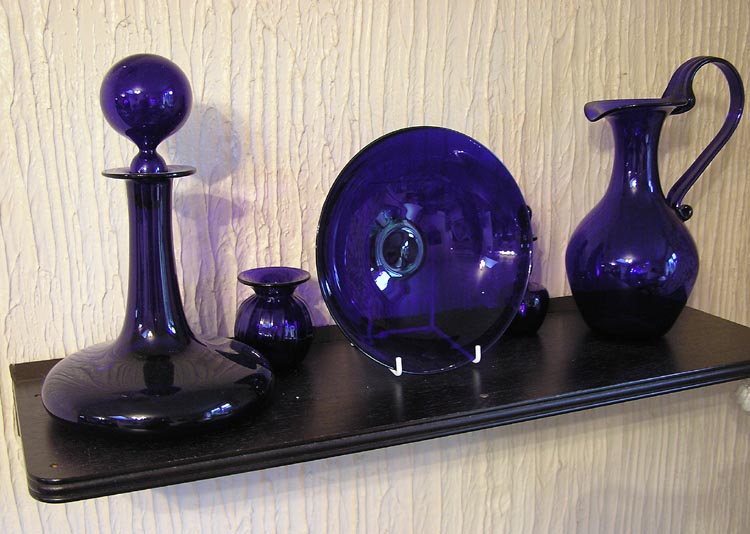
Cobalt glass is a vivid deep blue glass made by adding cobalt compounds such as cobalt oxide or carbonate to molten glass. Known as 'smalt' when ground for pigment, it has a long history in pottery, painting, and decorative glassware. Its colour is striking and stable in ceramics, making it a key blue in blue and white pottery and prized for its beauty in glass objects.
Share on WhatsAppOpen in the lab
- Cobalt glass gets its blue from cobalt oxide or carbonate.
- Known as smalt when ground for pigment use.
- Used in blue and white ceramics from China to Europe.
- Olive oil tasters use cobalt glass to avoid colour bias.
- Bristol blue glass is a famous collectible example.
What colour is Cobalt glass?
Cobalt glass is a type of glass with a strong, deep blue colour. This colour comes from adding a small amount of cobalt compound, usually cobalt oxide or carbonate, to the glass mixture. The blue is intense and stands out among other coloured glasses. When ground into a powder, cobalt glass is called smalt and has been used as a pigment. Its blue is stable in ceramics but can fade in paintings over time.
Where does Cobalt glass come from?
The earliest cobalt glass dates back to ancient Mesopotamia around 2000 BC, likely as a pigment. Cobalt oxide smalt was used in Egyptian pottery about 1500 BC and soon after in the Aegean. Chinese cobalt glass appears from the Zhou dynasty, and smalt was used in Central Asia by the 13th century. In Europe, it was common in paintings from the 15th to 17th centuries and used in laundry starch in Britain.
How is Cobalt glass made?
Cobalt glass is made by melting a cobalt compound, such as cobalt oxide or carbonate, with other glass ingredients like quartz and potassium carbonate. The process was used at industrial sites like Blaafarveværket in Norway. Only a small amount of cobalt is needed to give a strong blue colour. When ground, the glass becomes the pigment smalt.

![Plate, 1368-1644. Porcelain, underglaze, cobalt-blue decoration. Brooklyn Museum, Gift of Samuel P. Avery, by exchange, 51.85. Wikipedia Loves Art at the Brooklyn Museum This photo of item # [1] at the Brooklyn Museum wa](https://upload.wikimedia.org/wikipedia/commons/b/b4/WLA_brooklynmuseum_Plate_1368-1644_Ming_Porcelain.jpg)


Where Cobalt glass is used
Cobalt glass is used in decorative glassware, blue bottles, and as an optical filter in flame tests. Ground as smalt, it has coloured pottery, glass, and paintings. It is the main blue in blue and white ceramics such as Chinese porcelain and Delftware. Olive oil tasters use cobalt glass cups to mask the oil's colour during judging.
Blue around the world
What the blue family means from country to country.
Ancient craftsmen made Egyptian blue, one of the first synthetic pigments, and blue-glazed faience for amulets. Blue stood for the sky and the Nile.
Sacred and holyProtection and healingAweSource: Egyptian blueMany households hang a blue glass bead with an eye on it by the door or in the car to keep off the evil eye, known as hasad. Blue eye beads were already made in ancient Egypt.
Protection and healingSource: Nazar (amulet)Blue was the colour of the French kings, whose arms were gold lilies on blue. It is the first band of the tricolour, and national sports teams are called Les Bleus.
Politics and protestRoyalty and powerPrideSource: Bleu de France (colour)Lapis lazuli has been mined in the mountains of Badakhshan for more than six thousand years. Ground to powder it gave ultramarine, the costliest blue in European painting.
Royalty and powerSacred and holyAweSource: Lapis lazuliThe chadari is a full-length covering for women with a mesh panel over the eyes. In Kabul and the north it is most often a light blue.
Protection and healingSource: BurqaThe blue band of the flag stands for the wish of the Armenian people to live under peaceful skies. The red above it is for the highlands and the struggle to survive.
Politics and protestHopeSource: Flag of ArmeniaShades and relatives of Cobalt glass
Cobalt glass is closely related to cobalt blue, a pigment made from cobalt aluminate. Smalt is the name for ground cobalt glass used as a pigment. The blue can fade in paintings but remains stable in ceramics. Bristol blue glass is a well-known variety prized by collectors.
Colours that go with Cobalt glass
Harmonies are worked out from the value #003399. Contrast ratios follow the WCAG 2 formula.
Questions people ask about Cobalt glass
What colour is cobalt glass?
Cobalt glass is a deep, vivid blue. Its strong colour comes from adding a small amount of cobalt compound to the glass mixture.
Where does the name 'cobalt glass' come from?
The name comes from the cobalt compounds, such as cobalt oxide or carbonate, used to colour the glass blue.
What is smalt?
Smalt is the name for cobalt glass that has been ground into a powder and used as a pigment in painting, pottery, and glass decoration.
Where has cobalt glass been used historically?
It has been used in Mesopotamia, Egypt, China, Central Asia, and Europe, especially in pottery, glassware, and painting.
Is cobalt glass still used today?
Yes, it is still used in decorative glass, blue bottles, and as a pigment in ceramics, though less often in painting.
Good reading and sources
- Cobalt glass on WikipediaEncyclopedia
- More pictures on Wikimedia CommonsPictures
- Wikidata recordOpen data
The facts on this page come from the Wikipedia article "Cobalt glass", written by its contributors and used under the CC BY-SA 4.0 licence, and from its Wikidata record (CC0). Rang rewrote the text in its own words, with AI assistance, and compares every page with the article to make sure no passage is copied. It may be reused under the same CC BY-SA 4.0 licence with a link back.
It may contain mistakes. The swatch is an approximation: named colours are not fixed standards, and every screen shows them a little differently. If something is wrong, tell us. Last refreshed 2026-10-03.
More of the blue family
All of blue
Blue
Lapis lazuli
A deep blue stone prized for jewellery and the source of ultramarine pigmentColour named from nature · 🇦🇫 Afghanistan +5
#6A5DFF
Indigo
A deep blue named for the dye once exported from IndiaNamed shade · 🇮🇳 India +5

Blue
Azurite
A deep blue copper mineral once prized as a pigment and gemstonePigment · 🇫🇷 France +5

Blue
Woad
A blue dye once vital to Europe's textile trade, made from the leaves of a flowering plantDye · 🇫🇷 France +3
Blue
Indigo
A deep blue dye from plants, now mostly made synthetically and known for colouring denimDye · 🇮🇳 India +5
Blue
Methylene blue
A synthetic blue dye and medicine first made in 1876Dye
#120A8F
Ultramarine
A deep blue pigment once made from lapis lazuli, prized for centuries in artPigment · 🇦🇫 Afghanistan +2

#003153
Prussian blue
A deep blue pigment first made in Berlin in the early 1700sPigment · 🇯🇵 Japan
More colours tied to Egypt
The colours of Egypt
#FFFF00
Yellow
A primary colour between green and orange, seen in sunlight, leaves, and pigmentsBasic colour · 🇫🇷 France +5

Green
Malachite
A banded green mineral and pigment once prized for art and decorationColour named from nature · 🇪🇬 Egypt +4

#CC7722
Ochre
A natural earth pigment ranging from yellow to deep orange or brownPigment · 🇦🇺 Australia +5

#40E0D0
Turquoise
A blue-green colour named after a prized mineral long used for gems and decorationNamed shade · 🇮🇷 Iran +5