Sang de boeuf glaze
In its own language: 郎窑红
A deep red porcelain glaze first made in early 18th-century China
No single value: Sang de boeuf glaze is a material, and its colour varies. The background shows its family, red.

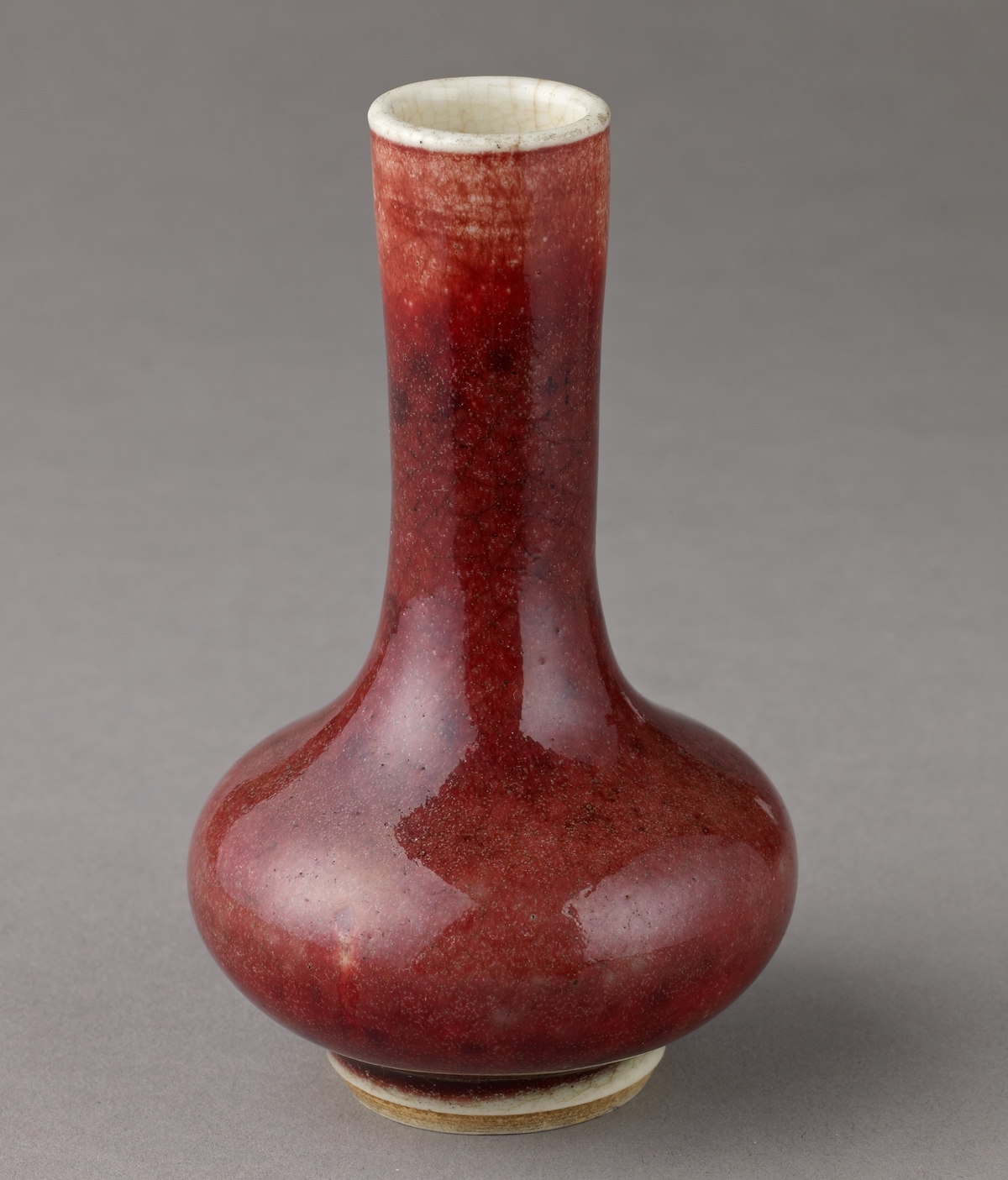
Sang de boeuf glaze is a rich red ceramic glaze, first seen on Chinese porcelain in the early 1700s. Its French name means "ox blood", and it is also called oxblood or Lang kiln red. The glaze is known for its unpredictable, decorative effects and is made using copper oxide in special kiln conditions.
- First made in Jingdezhen, China, around 1705–1712
- Named from the French for 'ox blood'
- Made with copper oxide in a reducing kiln atmosphere
- Shows crackle, bubbles, and colour streaks
- Used on London Underground station tiles
What colour is Sang de boeuf glaze?
Sang de boeuf glaze is a deep, rich red used on porcelain and ceramics. It stands out for its glassy surface, which can show crackles, bubbles, and streaks, with the colour sometimes fading to white at the top or thickening at the base. The glaze can also show greenish edges and sometimes hints of turquoise, lavender, or purple. Its unpredictable patterns and depth set it apart from other red glazes.
Where does Sang de boeuf glaze come from?
The name sang de boeuf comes from French, meaning "ox blood", and refers to the glaze's deep red colour. It was first developed in Jingdezhen, China, around 1705–1712, as an attempt to recreate the lost 'sacrificial red' glaze of the Ming dynasty. The original sacrificial red was used for imperial ritual vessels and was associated with the altar of the Sun. Later, the glaze became popular in the Qing dynasty and was admired for its historical links and decorative effects.
How is Sang de boeuf glaze made?
This glaze is made by adding copper oxide to the glaze mixture and firing it in a reducing atmosphere, which means the kiln has little or no oxygen. Sometimes, finishing in an oxidising atmosphere was also part of the process. The glaze is usually applied to the outside of closed shapes, often by spraying, with the inside and rim left clear. Achieving the right colour and effects is technically challenging and depends on many sensitive variables.



Where Sang de boeuf glaze is used
Sang de boeuf glaze was first used on Chinese porcelain, especially for imperial wares. It later became popular in the West, where potters in France, the United States, and England tried to reproduce it on both porcelain and stoneware. In the early 20th century, the glaze was used for architectural tiles on London Underground stations. Its decorative, varied surface made it prized for both art pottery and building decoration.
What Sang de boeuf glaze means
In Ming dynasty China, the original red glaze was used for ritual vessels and was linked to the altar of the Sun, giving it a sacred meaning in imperial ceremonies. The colour red was associated with specific directions and rituals in Chinese tradition. Later, sang de boeuf glaze became admired for its technical difficulty and beauty, especially in the context of Chinese ceramic art.
Red around the world
What the red family means from country to country.
Red stands for good fortune and happiness. Brides traditionally wear it, doors are hung with red couplets at New Year, and gifts of money come in red envelopes.
Luck and prosperityFestival and celebrationWeddings and marriageJoySource: Color in Chinese cultureThe national flag is red with five yellow stars. The red stands for the Communist revolution, and the same red runs through party banners and slogans.
Politics and protestPrideSource: Flag of ChinaThe red Phrygian cap, a soft cap with the tip pulled forward, became the sign of liberty in the Revolution. Marianne, the figure of the Republic, still wears it.
Politics and protestCourageSource: Phrygian capThe flag uses the four Pan-Arab colours: a red bar at the hoist with green, white and black bands. It was designed by a young Emirati, Abdullah Al Maainah, in 1971.
Politics and protestPrideSource: Flag of the United Arab EmiratesThe flag is a black double-headed eagle on red, the banner of the fifteenth-century hero Skanderbeg. Fans chant Kuq e Zi, red and black.
Politics and protestPrideSource: Flag of AlbaniaArmenian scribes painted manuscripts with vordan karmir, a crimson dye made from an insect that lives on the roots of grasses in the Ararat plain.
Sacred and holySource: Armenian cochinealShades and relatives of Sang de boeuf glaze
Other names for similar glazes include Lang kiln red and niúxiěhóng. The earlier Ming 'sacrificial red' was a subtle, mottled red, while sang de boeuf can show a wider range of effects, including streaks, crackle, and colour changes. Western versions often tried to match the depth and unpredictability of the Chinese original, but results varied.
Questions people ask about Sang de boeuf glaze
What colour is sang de boeuf glaze?
Sang de boeuf glaze is a deep, rich red, sometimes with streaks, crackle, and hints of other colours like green or purple. It is known for its glassy, layered look on porcelain and ceramics.
Where does the name sang de boeuf come from?
The name is French and means 'ox blood', describing the glaze's deep red colour. In Chinese, it is called Lang kiln red or niúxiěhóng.
How is sang de boeuf glaze made?
It is made by adding copper oxide to the glaze and firing it in a kiln with little or no oxygen. The process is technically difficult and can produce unpredictable but decorative effects.
Where was sang de boeuf glaze first used?
It was first used on porcelain made in Jingdezhen, China, in the early 18th century, mainly for imperial wares.
What is special about sang de boeuf glaze?
Its colour and surface effects are hard to control, leading to unique, decorative patterns. This unpredictability and depth are highly valued in both Chinese and Western ceramics.
Good reading and sources
- Sang de boeuf glaze on WikipediaEncyclopedia
- More pictures on Wikimedia CommonsPictures
- Wikidata recordOpen data
The facts on this page come from the Wikipedia article "Sang de boeuf glaze", written by its contributors and used under the CC BY-SA 4.0 licence, and from its Wikidata record (CC0). Rang rewrote the text in its own words, with AI assistance, and compares every page with the article to make sure no passage is copied. It may be reused under the same CC BY-SA 4.0 licence with a link back.
It may contain mistakes. The swatch is an approximation: named colours are not fixed standards, and every screen shows them a little differently. If something is wrong, tell us. Last refreshed 2026-10-03.
More of the red family
All of red
Red
Cinnabar
A scarlet to brick-red mineral and the main source of mercury and vermilion pigmentColour named from nature · 🇪🇸 Spain +5

Red
Realgar
An orange-red arsenic sulfide mineral once used as a pigment and poisonPigment · 🇨🇳 China +5

#E25822
Scarlet
A bright red with a touch of orange, long tied to power, sacrifice and sinNamed shade · 🇹🇷 Turkey +4

#E34234
Vermilion
A brilliant orange-red pigment, once made from toxic mercury orePigment · 🇹🇷 Turkey +5

Red
Rubia
A group of plants whose roots once dyed cloth and paint a lasting redColour named from nature · 🇪🇬 Egypt +5

#DC143C
Crimson
A deep red with a hint of purple, once made from insectsNamed shade · 🇳🇵 Nepal

#800000
Maroon
A deep brownish red named for the French word for chestnutNamed shade · 🇦🇺 Australia +4

Red
Sindoorसिन्दूर
A red or orange-red powder marking marriage for Hindu women in South AsiaTraditional colour · 🇮🇳 India +4
More colours tied to China
The colours of China
#FF0000
Red
A primary colour seen in light, pigment, and tradition worldwideBasic colour · 🇺🇸 United States +5

#FFFF00
Yellow
A primary colour between green and orange, seen in sunlight, leaves, and pigmentsBasic colour · 🇫🇷 France +5

#800080
Purple
A cool colour between red and blue, long linked with royalty and rarityBasic colour · 🇱🇧 Lebanon +5

Brown
Terracotta
A clay-based material and colour, known for its reddish-brown toneColour named from nature · 🇮🇳 India +4