Vermilion
A brilliant orange-red pigment, once made from toxic mercury ore

Vermilion is a vivid orange-red colour and a historic pigment, originally made by grinding the mineral cinnabar, which is mercury sulfide. Used in art, lacquerware, and ritual since ancient times, it is known for its brilliance but also for its toxicity. Its name comes from a dye made from insects, but the pigment itself is mineral-based.
Share on WhatsAppOpen in the lab
- Made from toxic mercury ore called cinnabar
- Used in art and ritual since at least 7000 BC
- Main red pigment in European painting until the 20th century
- Chinese lacquerware is famous for its vermilion colour
- Still used as sindoor in Hindu marriage rituals
What colour is Vermilion?
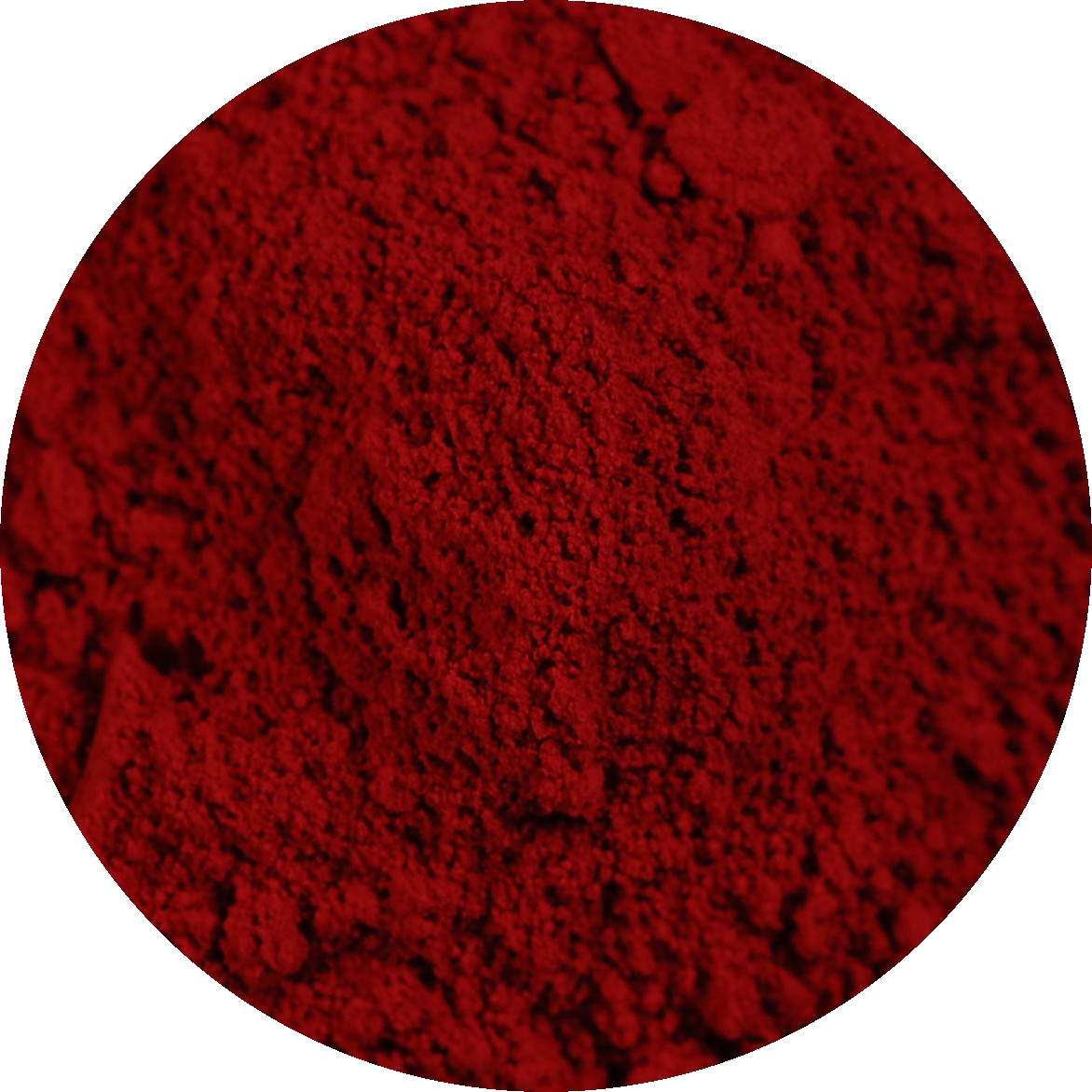
Vermilion is a strong, bright orange-red colour, often described as vivid and opaque. It stands out for its clarity and density, and was long valued for its intensity in painting and decoration. The pigment is not a single exact shade, but covers a range from bright orange-red to a duller, liver-like red, depending on how finely the mineral is ground. Its brilliance and opacity set it apart from other reds, but it is also known for being toxic.
Where does Vermilion come from?
The name 'vermilion' comes from the Old French 'vermeillon', itself from Latin 'vermiculus', meaning 'little worm', after the insect used for the kermes dye. The pigment, however, is mineral in origin, made from cinnabar, a mercury ore. Its use dates back to Neolithic Turkey and ancient China, and it was prized in Rome, Byzantium, and across Asia. Synthetic versions were developed in China and Persia, and the pigment was widely used in Europe from the Middle Ages onward.
How is Vermilion made?
Traditionally, vermilion pigment was made by grinding cinnabar, a naturally occurring mercury sulfide mineral. Later, synthetic vermilion was produced by heating mercury and sulfur together, then collecting and grinding the resulting mercury sulfide crystals. The process is hazardous due to mercury's toxicity. Today, most vermilion is synthetic, labelled as PR-106, and is still highly toxic.


Where Vermilion is used
Vermilion has been used in painting, illuminated manuscripts, lacquerware, ceramics, and body decoration. It was the main red pigment for European artists from the Renaissance until the 20th century. In China, it coloured lacquerware and imperial seals, while in India, it is worn as sindoor by married Hindu women. It has also decorated temples, statues, and manuscripts across cultures.
What Vermilion means
In China, vermilion was the colour of blood and life, used for temples, imperial carriages, and seals, and associated with eternity in Taoism. In India, it marks marriage and is used in Hindu rituals. In the Byzantine Empire, it was reserved for imperial use. In Christianity, it symbolises the Virgin Mary. Its meanings are sacred, royal, and celebratory, varying by culture.
Red around the world
What the red family means from country to country.
Red stands for good fortune and happiness. Brides traditionally wear it, doors are hung with red couplets at New Year, and gifts of money come in red envelopes.
Luck and prosperityFestival and celebrationWeddings and marriageJoySource: Color in Chinese cultureThe national flag is red with five yellow stars. The red stands for the Communist revolution, and the same red runs through party banners and slogans.
Politics and protestPrideSource: Flag of ChinaThe flag is red and yellow, the rojigualda. The colours were chosen for the navy in 1785 because they stood out at sea, and the men's football team is called La Roja.
Politics and protestPrideSource: Flag of SpainIn the last part of a bullfight the matador uses a small red cape, the muleta. Bulls do not see red as we do. It is the movement that draws them, and the colour hides the blood.
Danger and warningCourageSource: BullfightingAt the San Fermin festival in Pamplona each July, runners and crowds dress in white with a red neckerchief and red sash.
Festival and celebrationJoySource: Festival of San FermínMany Hindu brides marry in a red sari or lehenga. In much of north India a married woman wears sindoor, a red powder, along the parting of her hair.
Weddings and marriageLuck and prosperityJoyLoveSource: SindoorShades and relatives of Vermilion
Vermilion covers a range of orange-reds, from bright to duller, purplish reds. Its hue changes with the size of the pigment particles. It is sometimes confused with minium (red lead), which is less expensive and less stable. 'Chinese red' refers to a particularly pure form of vermilion used in Chinese lacquerware.
Colours that go with Vermilion
Harmonies are worked out from the value #E34234. Contrast ratios follow the WCAG 2 formula.
Questions people ask about Vermilion
What colour is vermilion?
Vermilion is a vivid orange-red, ranging from bright red-orange to a duller, purplish red depending on how it is made.
Where does the name 'vermilion' come from?
The name comes from Old French and Latin words for 'little worm', after the insect used for kermes dye, though the pigment itself is mineral-based.
How was vermilion pigment made?
It was originally made by grinding cinnabar, a mercury sulfide mineral. Later, it was produced synthetically by heating mercury and sulfur together.
Why is vermilion considered dangerous?
Vermilion contains mercury, which is highly toxic. Making and using the pigment requires great care to avoid mercury poisoning.
What is vermilion used for?
It has been used in painting, manuscript illumination, Chinese lacquerware, Hindu rituals, and as a colour for temples and imperial objects.
Good reading and sources
- Vermilion on WikipediaEncyclopedia
- More pictures on Wikimedia CommonsPictures
- Wikidata recordOpen data
The facts on this page come from the Wikipedia article "Vermilion", written by its contributors and used under the CC BY-SA 4.0 licence, and from its Wikidata record (CC0). Rang rewrote the text in its own words, with AI assistance, and compares every page with the article to make sure no passage is copied. It may be reused under the same CC BY-SA 4.0 licence with a link back.
It may contain mistakes. The swatch is an approximation: named colours are not fixed standards, and every screen shows them a little differently. If something is wrong, tell us. Last refreshed 2026-10-03.
More of the red family
All of red
Red
Cinnabar
A scarlet to brick-red mineral and the main source of mercury and vermilion pigmentColour named from nature · 🇪🇸 Spain +5

Red
Realgar
An orange-red arsenic sulfide mineral once used as a pigment and poisonPigment · 🇨🇳 China +5

#E25822
Scarlet
A bright red with a touch of orange, long tied to power, sacrifice and sinNamed shade · 🇹🇷 Turkey +4
Red
Carmine
A deep red pigment made from cochineal insects, once prized across continentsPigment · 🇫🇷 France +2

Red
Rubia
A group of plants whose roots once dyed cloth and paint a lasting redColour named from nature · 🇪🇬 Egypt +5

#DC143C
Crimson
A deep red with a hint of purple, once made from insectsNamed shade · 🇳🇵 Nepal

#E32636
Alizarin
A deep red dye first made from madder roots, later produced from coal tarDye · 🇹🇷 Turkey +1

#800000
Maroon
A deep brownish red named for the French word for chestnutNamed shade · 🇦🇺 Australia +4
More colours tied to Turkey
The colours of Turkey
#40E0D0
Turquoise
A blue-green colour named after a prized mineral long used for gems and decorationNamed shade · 🇮🇷 Iran +5
#E32636
Rose madder
A traditional red pigment made from the roots of the madder plantPigment · 🇪🇬 Egypt +5
#A91101
Turkey red
A lasting bright red dye for cotton, made from madder root by a complex processNamed shade · 🇹🇷 Turkey +4

Red
Armenian cochinealորդան կարմիր
A crimson dye once prized across Armenia and the Middle East, made from a rare insectDye · 🇦🇲 Armenia +4