Rose madder
A traditional red pigment made from the roots of the madder plant
Rose madder is a red pigment and dye made from the roots of the madder plant, Rubia tinctorum. It produces a transparent, slightly dull violet-red paint that fades over time, and was widely used in art and textiles before being replaced by synthetic alternatives.
Share on WhatsAppOpen in the lab
- Made from the roots of Rubia tinctorum
- Used as a dye in Egypt as early as 1500 BC
- Contains the dyes alizarin and purpurin
- Fades quickly in light (fugitive pigment)
- Replaced by synthetic alizarin after 1868
What colour is Rose madder?
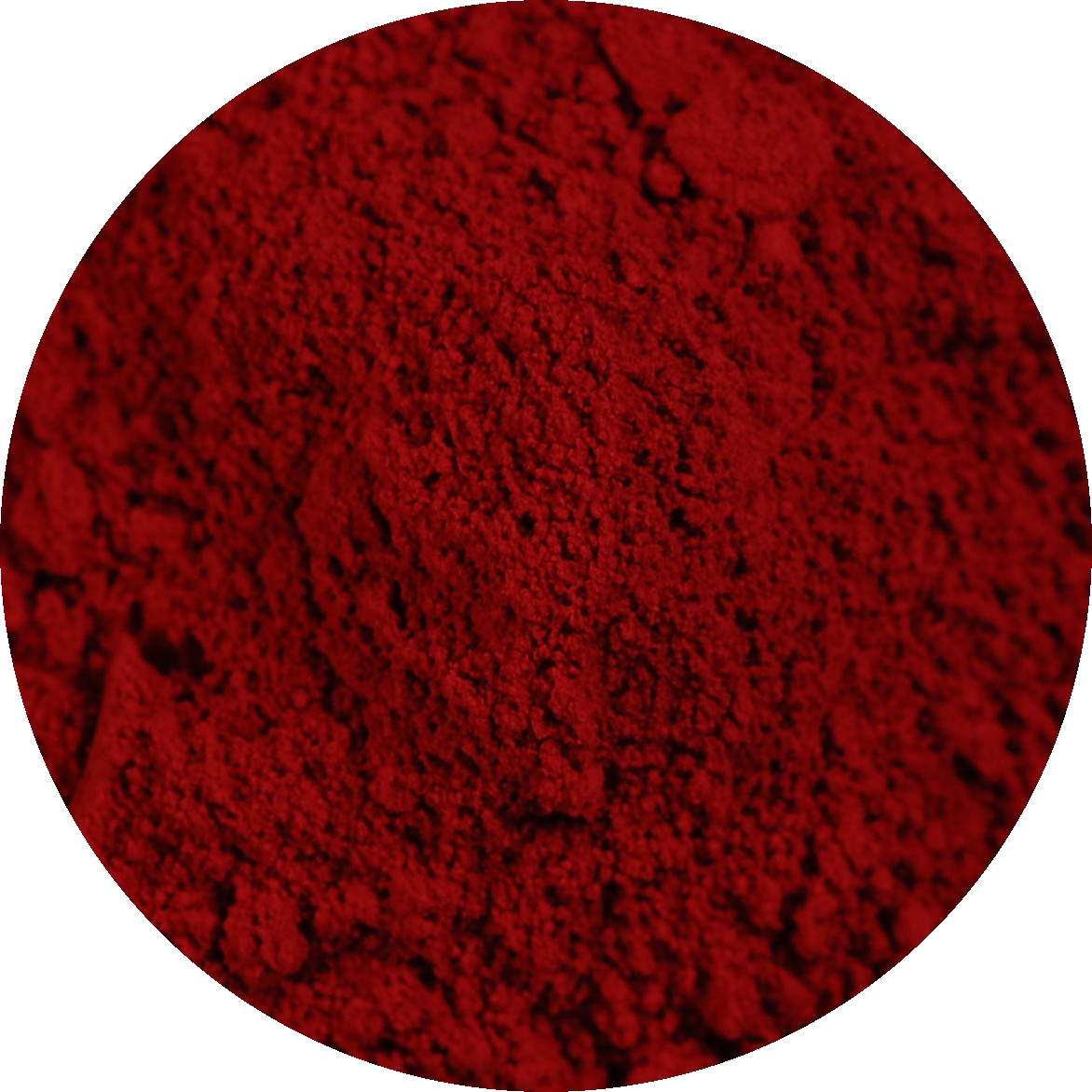
Rose madder is a red pigment made from the roots of the madder plant. The colour is a transparent, moderately dull violet-red in lighter mixes and becomes a darker, dull magenta red when used thickly. It is known for fading quickly when exposed to light, which makes it less suitable for works that need to last. Its gentle, warm red sets it apart from brighter or more permanent reds.
Where does Rose madder come from?
The pigment comes from the common madder plant, Rubia tinctorum, which has been grown for dye since ancient times. Madder was cultivated in Egypt as early as 1500 BC and used in Greece, Italy, and Spain. The Egyptians are thought to have first made a lake pigment from madder. The name 'rose madder' refers to the pinkish red shade produced from the plant's root.
How is Rose madder made?
To make rose madder, the roots of the madder plant are processed to extract dyes, mainly alizarin and purpurin. These dyes are combined with substances like alum and chalk to form a lake pigment, which can then be used in paint or dye. The best colour comes from plants grown in lime-rich soil and harvested at a certain age.
Where Rose madder is used
Rose madder has been used to dye textiles and in painting for thousands of years. It coloured ancient Egyptian cloth and appeared in Roman wall paintings and ceramics. Artists such as J. M. W. Turner used it in their work. The pigment was also used in military uniforms, such as the British red coats and French 'Turkey Red' cloth.
Red around the world
What the red family means from country to country.
The ancient Egyptians called the desert deshret, the red land. Red was the colour of the god Set, of chaos and of danger, and scribes wrote unlucky words in red ink.
Danger and warningFearSource: RedThe flag is red, white and black. Red recalls the struggle before the 1952 revolution, white the revolution itself, which was nearly bloodless, and black the end of oppression.
Politics and protestPrideSource: Flag of EgyptThe flag is red and yellow, the rojigualda. The colours were chosen for the navy in 1785 because they stood out at sea, and the men's football team is called La Roja.
Politics and protestPrideSource: Flag of SpainIn the last part of a bullfight the matador uses a small red cape, the muleta. Bulls do not see red as we do. It is the movement that draws them, and the colour hides the blood.
Danger and warningCourageSource: BullfightingAt the San Fermin festival in Pamplona each July, runners and crowds dress in white with a red neckerchief and red sash.
Festival and celebrationJoySource: Festival of San FermínEggs are dyed red on the Thursday before Easter to stand for the blood of Christ. After the midnight service families crack them against each other.
Sacred and holyFestival and celebrationJoySource: Easter eggShades and relatives of Rose madder
There are several related pigments and substitutes for rose madder. Alizarin crimson is a synthetic pigment similar in colour. Quinacridone pigments and other modern reds have replaced rose madder in most uses because they are more permanent. 'Rose madder genuine' refers to the traditional, plant-derived pigment, while 'rose madder hue' describes imitations made from other materials.
Colours that go with Rose madder
Harmonies are worked out from the value #E32636. Contrast ratios follow the WCAG 2 formula.
Questions people ask about Rose madder
What colour is rose madder?
Rose madder is a transparent, moderately dull violet-red pigment that can appear pinkish in tints and a darker magenta red when used thickly.
Where does the name 'rose madder' come from?
The name comes from the madder plant, Rubia tinctorum, whose roots are used to make the pigment. The 'rose' part refers to the pinkish red shade it produces.
How is rose madder made?
Rose madder is made by extracting dyes from madder roots and combining them with alum and chalk to form a lake pigment suitable for paint or dye.
Why is rose madder no longer widely used?
Rose madder fades quickly when exposed to light, making it unsuitable for lasting works. It was replaced by synthetic alizarin and later by more permanent pigments.
What are some substitutes for rose madder?
Modern substitutes include synthetic alizarin crimson and quinacridone pigments, which offer similar colours with much better permanence.
Good reading and sources
The facts on this page come from the Wikipedia article "Rose madder", written by its contributors and used under the CC BY-SA 4.0 licence, and from its Wikidata record (CC0). Rang rewrote the text in its own words, with AI assistance, and compares every page with the article to make sure no passage is copied. It may be reused under the same CC BY-SA 4.0 licence with a link back.
It may contain mistakes. The swatch is an approximation: named colours are not fixed standards, and every screen shows them a little differently. If something is wrong, tell us. Last refreshed 2026-10-03.
More of the red family
All of red
Red
Cinnabar
A scarlet to brick-red mineral and the main source of mercury and vermilion pigmentColour named from nature · 🇪🇸 Spain +5

Red
Realgar
An orange-red arsenic sulfide mineral once used as a pigment and poisonPigment · 🇨🇳 China +5
Red
Carmine
A deep red pigment made from cochineal insects, once prized across continentsPigment · 🇫🇷 France +2

#E25822
Scarlet
A bright red with a touch of orange, long tied to power, sacrifice and sinNamed shade · 🇹🇷 Turkey +4

#E34234
Vermilion
A brilliant orange-red pigment, once made from toxic mercury orePigment · 🇹🇷 Turkey +5

Red
Rubia
A group of plants whose roots once dyed cloth and paint a lasting redColour named from nature · 🇪🇬 Egypt +5

#DC143C
Crimson
A deep red with a hint of purple, once made from insectsNamed shade · 🇳🇵 Nepal

#E32636
Alizarin
A deep red dye first made from madder roots, later produced from coal tarDye · 🇹🇷 Turkey +1
More colours tied to Egypt
The colours of Egypt
#FFFF00
Yellow
A primary colour between green and orange, seen in sunlight, leaves, and pigmentsBasic colour · 🇫🇷 France +5

Blue
Lapis lazuli
A deep blue stone prized for jewellery and the source of ultramarine pigmentColour named from nature · 🇦🇫 Afghanistan +5

Green
Malachite
A banded green mineral and pigment once prized for art and decorationColour named from nature · 🇪🇬 Egypt +4

Blue
Azurite
A deep blue copper mineral once prized as a pigment and gemstonePigment · 🇫🇷 France +5