Carmine
A deep red pigment made from cochineal insects, once prized across continents
No single value: Carmine is a material, and its colour varies. The background shows its family, red.
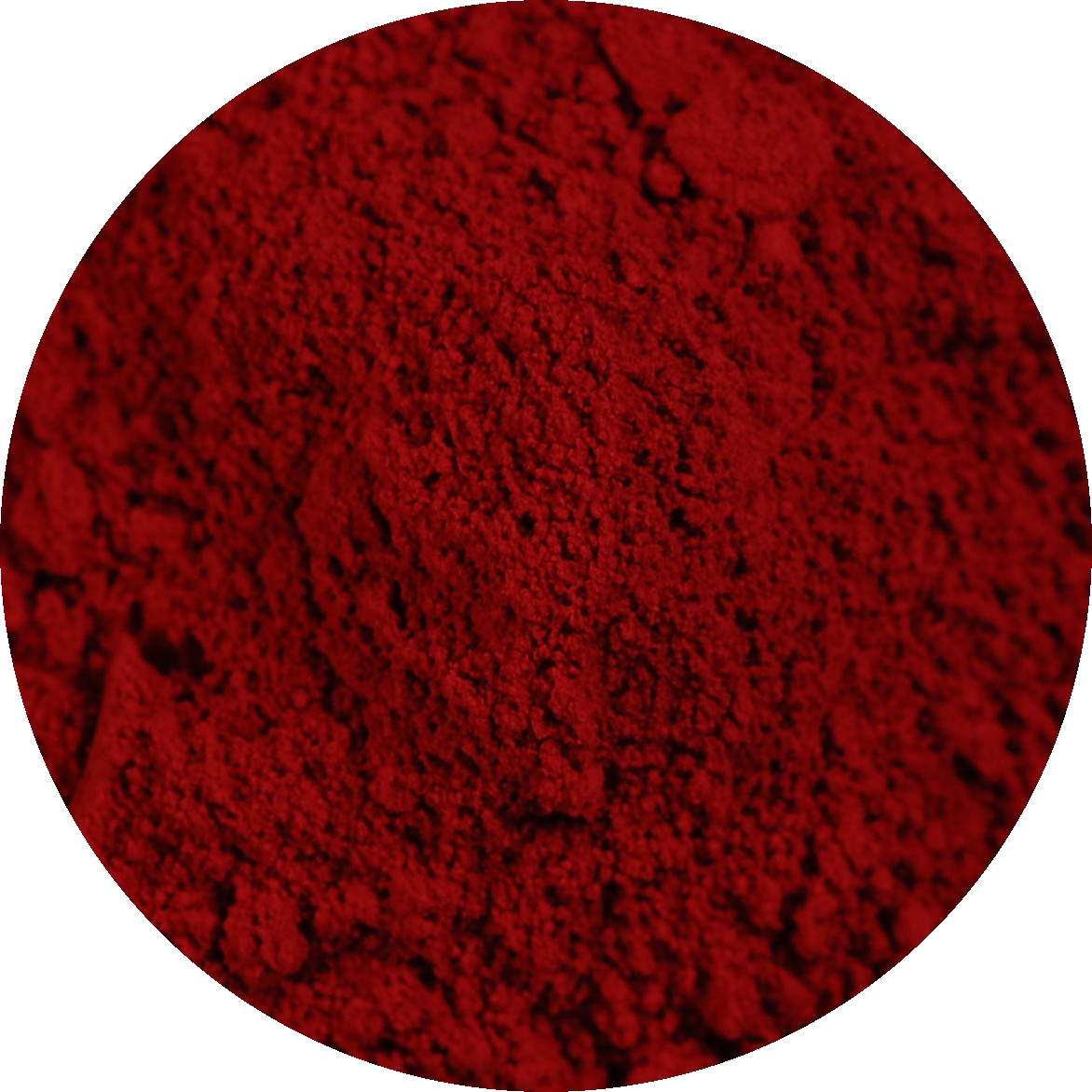
Carmine is a vivid red pigment produced from carminic acid, mainly extracted from cochineal insects. Its intense colour has coloured textiles, paintings, food, and cosmetics for centuries, especially in the Americas and Europe. The name traces back through French, Latin, Arabic, Armenian, and Persian, all meaning 'red' or 'insect-produced'.
- Made from cochineal insects, mainly in the Americas
- Used in art, textiles, food, and cosmetics for centuries
- It takes about 70,000 insects to make 1 pound of dye
- Fades quickly when exposed to light
- Known as E120 in food and regulated in many countries
What colour is Carmine?
Carmine is a strong, bright red that can range from a pure, clear crimson to a darker purplish red depending on how it is prepared. It is most often made from the carminic acid found in certain scale insects, especially the cochineal. The pigment is known for its intensity and translucence, which can vary with the medium used. Carmine stands out among reds for its insect origin and its historical role in both art and industry.
Where does Carmine come from?
The word 'carmine' comes through French, Latin, Arabic, and Armenian, all tracing back to Persian words for 'red' or 'insect-produced'. The pigment itself has been used since at least 700 BC, with American civilisations such as the Aztecs and Incas extracting it from insects on cacti. It reached Europe in the 16th century, where it became a valuable trade good, especially under Spanish control. The English colour name dates to 1799.
How is Carmine made?
To make carmine, dried cochineal insects are powdered and boiled in an ammonia or sodium carbonate solution. The liquid is filtered, then alum is added to form a red solid called 'carmine lake'. Other chemicals like tin or zinc salts may be added to adjust the shade. It takes about 70,000 insects to produce half a kilogram of dye. Synthetic carminic acid exists but is rarely used due to cost and complexity.


Where Carmine is used
Carmine has coloured textiles, paintings, and cosmetics since ancient times. The Aztecs and Incas dyed fabrics with it, and European painters such as Tintoretto, Van Gogh, and Turner used it for its rich red tones, though it fades with light. It is also used in food (as E120), medicines, and cosmetics like lipstick and rouge. In maps, it was used to mark buildings and fortifications.
What Carmine means
Red, including carmine, has long been linked with power and social status, worn by rulers and military leaders. The sources do not tie carmine itself to specific religious or emotional meanings, but its use in ceremonial dress and art reflects its value and prestige in various cultures.
Red around the world
What the red family means from country to country.
The red Phrygian cap, a soft cap with the tip pulled forward, became the sign of liberty in the Revolution. Marianne, the figure of the Republic, still wears it.
Politics and protestCourageSource: Phrygian capOn the last Tuesday night before Nowruz, people jump over small bonfires and chant a line that gives their yellow, meaning sickness, to the fire and takes its red, meaning health.
Festival and celebrationProtection and healingEnergySource: Chaharshanbe SuriOn Yalda, the longest night of the year, families sit up late eating pomegranates and watermelon. The red fruit stands for the glow of dawn and of life.
Festival and celebrationHopeSource: Yalda NightSince the television maps of the 2000 election, red has meant the Republican Party and blue the Democrats, giving the phrases red state and blue state. Before then the networks had no fixed scheme.
Politics and protestSource: Red states and blue statesThe flag uses the four Pan-Arab colours: a red bar at the hoist with green, white and black bands. It was designed by a young Emirati, Abdullah Al Maainah, in 1971.
Politics and protestPrideSource: Flag of the United Arab EmiratesThe flag is a black double-headed eagle on red, the banner of the fifteenth-century hero Skanderbeg. Fans chant Kuq e Zi, red and black.
Politics and protestPrideSource: Flag of AlbaniaShades and relatives of Carmine
The exact hue of carmine depends on the metal salts used in its preparation. Adding zinc or aluminium produces a crimson shade, while lime can shift it towards purple. Carmine is sometimes confused with other red pigments like kermes, but is distinct in its insect origin. Over time, carmine can fade to brownish or bluish tones, especially in paintings exposed to light.
Questions people ask about Carmine
What colour is carmine?
Carmine is a deep, bright red pigment that can appear crimson or purplish red depending on how it is made and the medium it is used in.
Where does the name 'carmine' come from?
The name comes from French, Latin, Arabic, Armenian, and Persian words meaning 'red' or 'insect-produced', reflecting its origins as a dye made from insects.
How is carmine made?
Carmine is made by boiling powdered cochineal insects in a solution, filtering it, and adding alum to form the red pigment. Other chemicals can be added to adjust the shade.
What is carmine used for?
Carmine is used to colour textiles, paintings, cosmetics, foods, and medicines. It has been valued in art and industry since ancient times.
Why does carmine fade?
Carmine is sensitive to light and humidity, which can cause it to fade or change colour, especially in watercolours and textiles.
Good reading and sources
The facts on this page come from the Wikipedia article "Carmine", written by its contributors and used under the CC BY-SA 4.0 licence, and from its Wikidata record (CC0). Rang rewrote the text in its own words, with AI assistance, and compares every page with the article to make sure no passage is copied. It may be reused under the same CC BY-SA 4.0 licence with a link back.
It may contain mistakes. The swatch is an approximation: named colours are not fixed standards, and every screen shows them a little differently. If something is wrong, tell us. Last refreshed 2026-10-03.
More of the red family
All of red
Red
Cinnabar
A scarlet to brick-red mineral and the main source of mercury and vermilion pigmentColour named from nature · 🇪🇸 Spain +5

Red
Realgar
An orange-red arsenic sulfide mineral once used as a pigment and poisonPigment · 🇨🇳 China +5

#E25822
Scarlet
A bright red with a touch of orange, long tied to power, sacrifice and sinNamed shade · 🇹🇷 Turkey +4

Red
Rubia
A group of plants whose roots once dyed cloth and paint a lasting redColour named from nature · 🇪🇬 Egypt +5

#E34234
Vermilion
A brilliant orange-red pigment, once made from toxic mercury orePigment · 🇹🇷 Turkey +5

#E32636
Alizarin
A deep red dye first made from madder roots, later produced from coal tarDye · 🇹🇷 Turkey +1

#801818
Falu redfalu rödfärg
A deep red paint pigment from the Falun copper mine, used on wooden houses in SwedenPigment · 🇸🇪 Sweden +2

Red
Hennaحِنَّاء
A reddish dye from the henna plant, used for body art and hair since ancient timesColour named from nature · 🇪🇬 Egypt +5
More colours tied to France
The colours of France
#FFFF00
Yellow
A primary colour between green and orange, seen in sunlight, leaves, and pigmentsBasic colour · 🇫🇷 France +5

#800080
Purple
A cool colour between red and blue, long linked with royalty and rarityBasic colour · 🇱🇧 Lebanon +5

#FF00FF
Magenta
A purplish-pink colour named after a battle and key to modern printingNamed shade · 🇫🇷 France +4

Brown
Terracotta
A clay-based material and colour, known for its reddish-brown toneColour named from nature · 🇮🇳 India +4