Alizarin
A deep red dye first made from madder roots, later produced from coal tar

Alizarin is a rich red dye that was once extracted from madder plant roots and later made from coal tar. It colours textiles, is used in artists’ paints, and helps scientists stain calcium in biological samples. Its vivid red, called Turkey Red, was highly prized for cloth and pigment.
Share on WhatsAppOpen in the lab
- First red dye to be made from both plants and coal tar
- Key ingredient in rose madder and alizarin crimson paints
- Used to stain calcium in biological and geological samples
- Turkey Red was a famous bright red for textiles
- Colour changes with acidity, acting as a pH indicator
What colour is Alizarin?
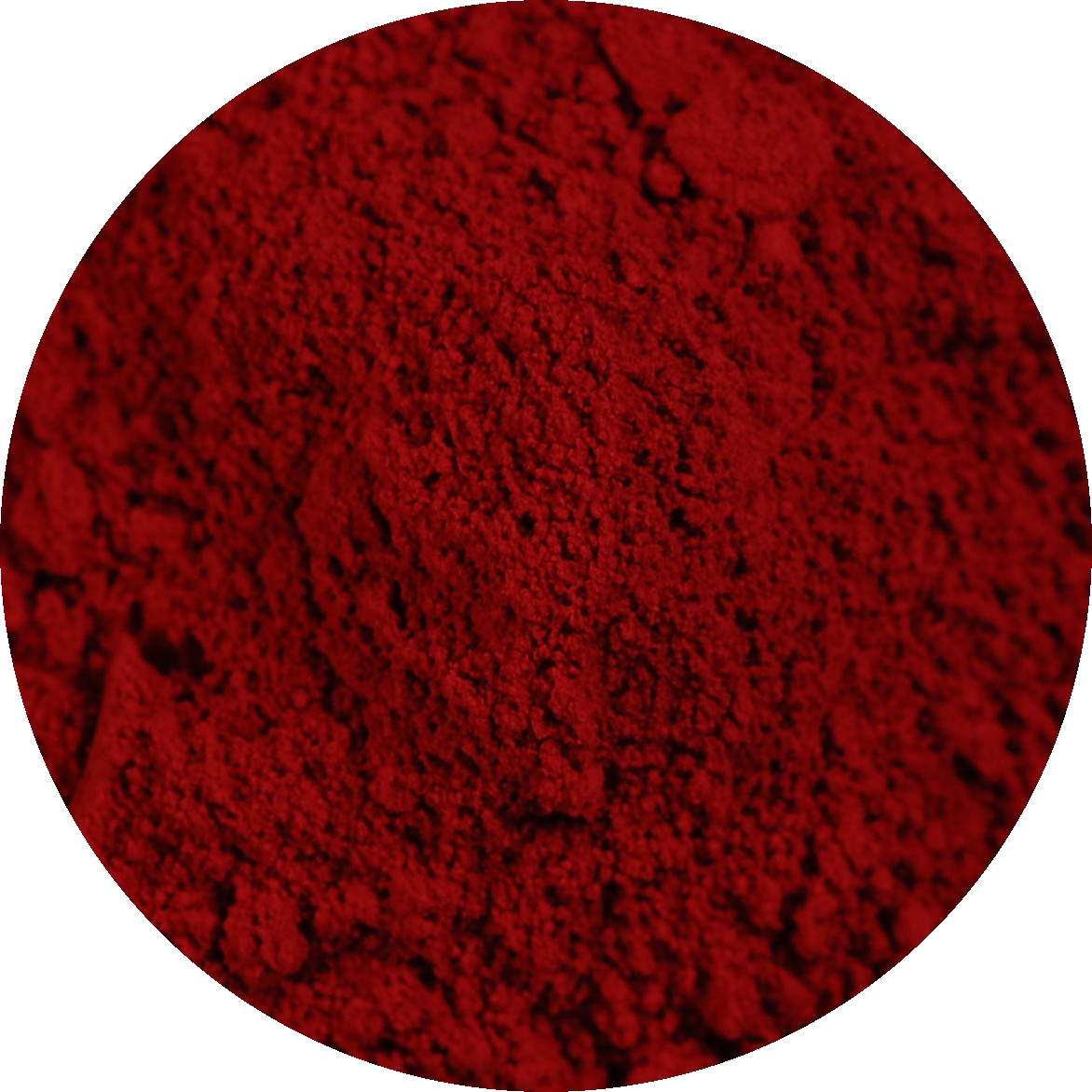
Alizarin is a strong red dye and pigment. It was first obtained from the roots of madder plants, giving a colour that ranges from pink to deep red depending on how it is fixed to fabric or pigment. As a pigment, it appears in paints as rose madder or alizarin crimson. Its colour can shift with changes in acidity, and it forms crystals with a red-purple hue.
Where does Alizarin come from?
The dye comes from madder plants, which have been grown for their colouring roots since at least 1500 BC in places like Egypt and central Asia. The name 'Turkey Red' refers to a bright red shade developed in the Middle East. In the 19th century, chemists found ways to make alizarin from coal tar, making it much cheaper and ending the need to grow madder for dye.
How is Alizarin made?
Originally, alizarin was extracted from madder root. The roots were processed and combined with substances called mordants, which help the dye bind to fabric or pigment. Later, chemists made alizarin from anthracene, a compound found in coal tar, by a series of chemical steps. Today, it is made by oxidising anthraquinone or its sulfonate in alkaline conditions.


Where Alizarin is used
Alizarin has coloured cloth for thousands of years, especially in the form of Turkey Red. It was used for the red uniforms of British soldiers and in artists’ paints as madder lake and alizarin crimson. In science, it stains calcium in tissues, bones, and geological samples, making these structures easier to see under a microscope.
Red around the world
What the red family means from country to country.
The ancient Egyptians called the desert deshret, the red land. Red was the colour of the god Set, of chaos and of danger, and scribes wrote unlucky words in red ink.
Danger and warningFearSource: RedThe flag is red, white and black. Red recalls the struggle before the 1952 revolution, white the revolution itself, which was nearly bloodless, and black the end of oppression.
Politics and protestPrideSource: Flag of EgyptThe flag is red with a white crescent and star, and is called al bayrak, the red flag. It comes down from the late Ottoman flag.
Politics and protestPrideSource: Flag of TurkeyTurkey red was a bright, fast red for cotton, made from madder root by a long process worked out around Edirne. European dyers spent much of the 1700s trying to copy it.
Nature and renewalSource: Turkey redThe flag uses the four Pan-Arab colours: a red bar at the hoist with green, white and black bands. It was designed by a young Emirati, Abdullah Al Maainah, in 1971.
Politics and protestPrideSource: Flag of the United Arab EmiratesThe flag is a black double-headed eagle on red, the banner of the fifteenth-century hero Skanderbeg. Fans chant Kuq e Zi, red and black.
Politics and protestPrideSource: Flag of AlbaniaShades and relatives of Alizarin
Alizarin is closely related to other dyes from madder, such as purpurin, which fades more quickly. The name alizarin also appears in dyes of other colours, like Alizarine Cyanine Green and Alizarine Brilliant Blue, but these are chemically different. The pigment can vary in shade depending on the metal salt used to fix it.
Colours that go with Alizarin
Harmonies are worked out from the value #E32636. Contrast ratios follow the WCAG 2 formula.
Questions people ask about Alizarin
What colour is alizarin?
Alizarin is a deep red dye and pigment, sometimes appearing pink or purple depending on how it is used and what it is combined with.
Where does the name alizarin come from?
The name alizarin comes from its historic use as a dye from madder roots, with 'Turkey Red' referring to a prized shade developed in the Middle East.
How was alizarin first made?
Alizarin was first obtained from the roots of the madder plant, which were processed and combined with mordants to fix the dye to fabric or pigment.
Is alizarin still used today?
Alizarin is still used, but less than before. It appears in artists’ paints and scientific staining, but has been replaced in many uses by newer synthetic pigments.
What is alizarin used for in science?
In science, alizarin is used to stain calcium in tissues and bones, helping researchers see these structures under a microscope.
Good reading and sources
The facts on this page come from the Wikipedia article "Alizarin", written by its contributors and used under the CC BY-SA 4.0 licence, and from its Wikidata record (CC0). Rang rewrote the text in its own words, with AI assistance, and compares every page with the article to make sure no passage is copied. It may be reused under the same CC BY-SA 4.0 licence with a link back.
It may contain mistakes. The swatch is an approximation: named colours are not fixed standards, and every screen shows them a little differently. If something is wrong, tell us. Last refreshed 2026-10-03.
More of the red family
All of red
Red
Cinnabar
A scarlet to brick-red mineral and the main source of mercury and vermilion pigmentColour named from nature · 🇪🇸 Spain +5

Red
Realgar
An orange-red arsenic sulfide mineral once used as a pigment and poisonPigment · 🇨🇳 China +5
Red
Carmine
A deep red pigment made from cochineal insects, once prized across continentsPigment · 🇫🇷 France +2

#E25822
Scarlet
A bright red with a touch of orange, long tied to power, sacrifice and sinNamed shade · 🇹🇷 Turkey +4

#E34234
Vermilion
A brilliant orange-red pigment, once made from toxic mercury orePigment · 🇹🇷 Turkey +5

Red
Rubia
A group of plants whose roots once dyed cloth and paint a lasting redColour named from nature · 🇪🇬 Egypt +5

#801818
Falu redfalu rödfärg
A deep red paint pigment from the Falun copper mine, used on wooden houses in SwedenPigment · 🇸🇪 Sweden +2

Red
Hennaحِنَّاء
A reddish dye from the henna plant, used for body art and hair since ancient timesColour named from nature · 🇪🇬 Egypt +5
More colours tied to Turkey
The colours of Turkey
#40E0D0
Turquoise
A blue-green colour named after a prized mineral long used for gems and decorationNamed shade · 🇮🇷 Iran +5
#E32636
Rose madder
A traditional red pigment made from the roots of the madder plantPigment · 🇪🇬 Egypt +5
#A91101
Turkey red
A lasting bright red dye for cotton, made from madder root by a complex processNamed shade · 🇹🇷 Turkey +4

Red
Armenian cochinealորդան կարմիր
A crimson dye once prized across Armenia and the Middle East, made from a rare insectDye · 🇦🇲 Armenia +4