Erythrosine
A bright red-pink synthetic dye used in food, cosmetics, and industry
No single value: Erythrosine is a material, and its colour varies. The background shows its family, red.
Erythrosine is a synthetic red-pink dye, classified as a derivative of fluorone and an organoiodine compound. First made in 1876, it has been widely used to colour foods, cosmetics, and textiles, though its use is now restricted in many countries due to safety concerns.
- First synthesised in 1876 by Karl Kussmaul in Switzerland
- Gives a bright red-pink colour to foods and cosmetics
- Made from fluorescein by iodination
- Use in food is now restricted or banned in many countries
- Fades when exposed to sunlight
What colour is Erythrosine?
Erythrosine is a synthetic dye that gives a bright red-pink colour. It is most often seen in foods, cosmetics, and some industrial products. As a derivative of fluorone, it stands out for its vivid hue and its ability to dissolve in water. Its colour is strong and clear, but it can fade when exposed to sunlight.
Where does Erythrosine come from?
The dye was first discovered in 1876 by Karl Kussmaul in Switzerland and soon produced commercially for dyeing wool and silk. Its name comes from its red appearance, and it is also known by several standard codes such as E127 and Red No. 3. Erythrosine's use in textiles was quickly replaced due to its tendency to lose colour in sunlight, but it found a lasting place as a food colouring.
How is Erythrosine made?
Erythrosine is made by chemically reacting resorcinol and phthalic anhydride to form fluorescein, which is then treated with iodine. This process produces the disodium salt of tetraiodofluorescein, resulting in the bright red dye. It is entirely synthetic and not found in nature.
Where Erythrosine is used
Erythrosine has been used to colour foods like sweets, cherries, and cake gels, as well as in cosmetics, hair dyes, and pet products. It is also found in printing inks, as a biological stain, and in dental plaque disclosing tablets. Its use in food and cosmetics is now limited or banned in several countries, but it remains permitted in certain products such as processed cherries and pet foods.
Red around the world
What the red family means from country to country.
Red ochre is used in Aboriginal rock art and ceremony, and is traded over long distances. In the Aboriginal flag the red half stands for the earth and for that ochre.
Sacred and holyNature and renewalAweSource: Australian Aboriginal flagRed and white are the national colours. The flag, a red maple leaf between two red bars, was adopted in 1965 after a long debate in parliament.
Politics and protestPrideSource: National colours of CanadaOfficers of the Royal Canadian Mounted Police wear the Red Serge, a scarlet tunic with a high collar, on ceremonial duty. It is one of the best known images of the country abroad.
Protection and healingTrustSource: Red SergeEmpty red dresses hung in public places stand for missing and murdered Indigenous women and girls. The idea comes from the REDress Project by the Metis artist Jaime Black.
Mourning and deathProtection and healingGriefSource: REDress ProjectEach November people pin on a red paper poppy to remember those killed in war. The flower grew on the battlefields of Flanders in the First World War.
Protection and healingDanger and warningNostalgiaSource: Remembrance poppyRed is the colour of the Labour Party, whose symbol is a red rose, and blue the colour of the Conservatives. Election maps are drawn in the two.
Politics and protestSource: Political colourShades and relatives of Erythrosine
Erythrosine is sometimes confused with other synthetic red dyes, but it is distinct for its iodine content and its particular shade. It is listed under several standard numbers, including FD&C Red No. 3 and E127. Other red dyes, such as Red No. 40, may be used in similar applications but have different chemical structures.
Questions people ask about Erythrosine
What colour is erythrosine?
Erythrosine is a bright red-pink dye, often used to give foods and cosmetics a vivid red appearance.
Where does the name erythrosine come from?
The name comes from its red colour; 'erythro-' is a prefix meaning red. It is also known by codes like E127 and Red No. 3.
How is erythrosine made?
It is made by synthesising fluorescein from resorcinol and phthalic anhydride, then adding iodine to produce the red dye.
Is erythrosine still used in food?
Its use in food is now restricted or banned in many countries, but it is still allowed in some products like processed cherries and pet foods.
Why was erythrosine banned or restricted?
Concerns about its safety, especially possible links to thyroid tumours in lab animals at high doses, led to bans and restrictions in the US, EU, and other countries.
Good reading and sources
- Erythrosine on WikipediaEncyclopedia
- More pictures on Wikimedia CommonsPictures
- Wikidata recordOpen data
The facts on this page come from the Wikipedia article "Erythrosine", written by its contributors and used under the CC BY-SA 4.0 licence, and from its Wikidata record (CC0). Rang rewrote the text in its own words, with AI assistance, and compares every page with the article to make sure no passage is copied. It may be reused under the same CC BY-SA 4.0 licence with a link back.
It may contain mistakes. The swatch is an approximation: named colours are not fixed standards, and every screen shows them a little differently. If something is wrong, tell us. Last refreshed 2026-10-03.
More of the red family
All of red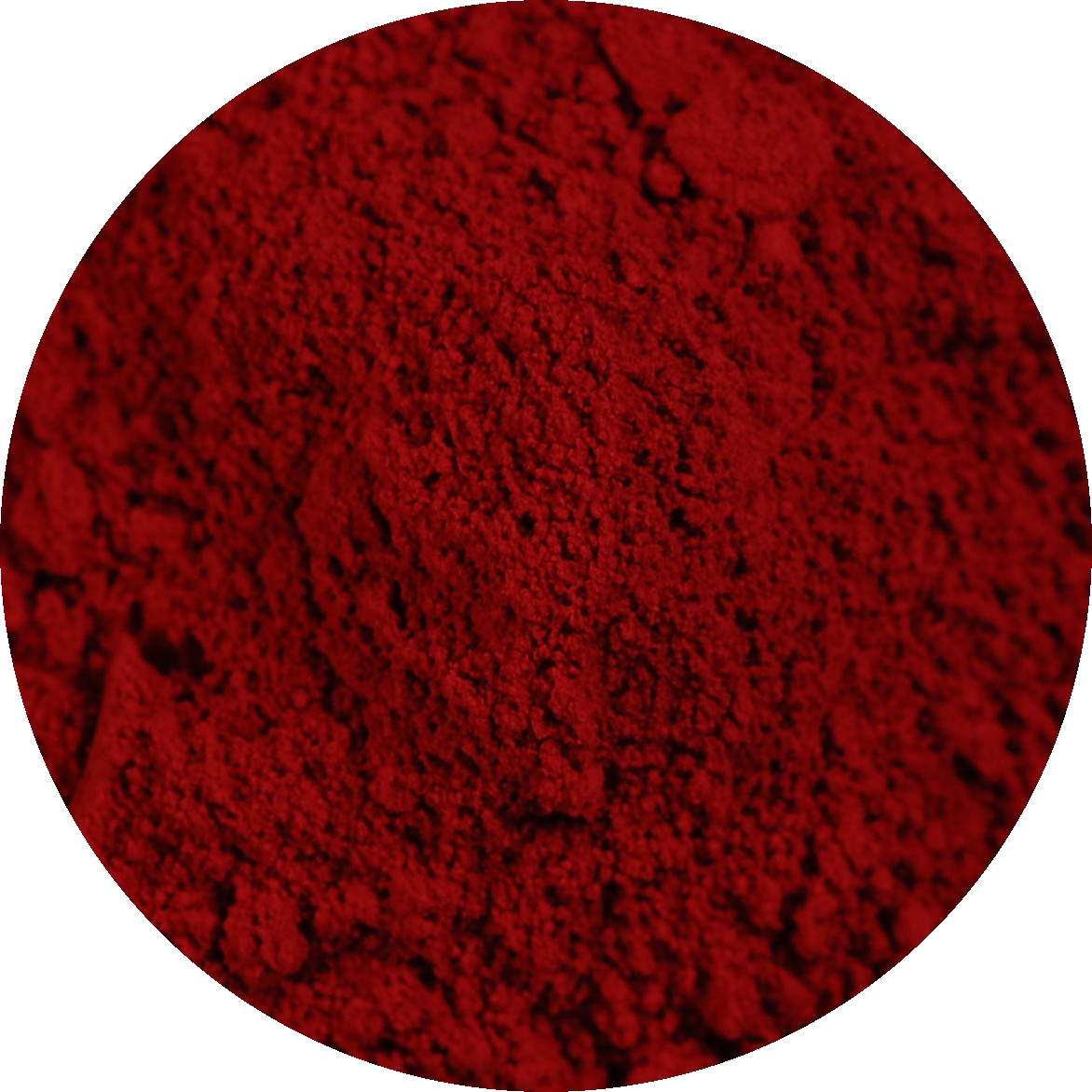
Red
Carmine
A deep red pigment made from cochineal insects, once prized across continentsPigment · 🇫🇷 France +2

Red
Rubia
A group of plants whose roots once dyed cloth and paint a lasting redColour named from nature · 🇪🇬 Egypt +5

#E32636
Alizarin
A deep red dye first made from madder roots, later produced from coal tarDye · 🇹🇷 Turkey +1

Red
Hennaحِنَّاء
A reddish dye from the henna plant, used for body art and hair since ancient timesColour named from nature · 🇪🇬 Egypt +5

#C41E3A
Cardinal
A strong, deep red linked to church robes and team coloursNamed shade

Red
Kermes
A deep red dye made from Mediterranean scale insects, once prized for scarlet clothDye · 🇪🇬 Egypt +5

Red
Kumkum
A red powder made from turmeric and lime, used for forehead marks in IndiaDye · 🇮🇳 India
Red
Brazilin
A red dye from brazilwood and sappanwood, used in textiles and paints since the Middle AgesDye · 🇧🇷 Brazil +4
More colours tied to the United States
The colours of the United States
#FF0000
Red
A long wavelength of light linked to blood, luck, and revolution.Basic colour · 🇪🇬 Egypt +5

#00FF00
Green
The spectral hue of living foliage, photosynthesis, and renewalBasic colour · 🇮🇪 Ireland +3

#FFFF00
Yellow
A bright spectral shade found in sunlight, autumn foliage, and ancient earth pigments.Colour named from nature · 🇫🇷 France +5

#FFFFFF
White
The lightest colour, seen in snow, milk and chalk, and opposite to blackBasic colour · 🇪🇬 Egypt +5