Green
The colour between cyan and yellow, seen widely in plants and nature

Green is the colour found between cyan and yellow on the visible spectrum, with light of about 495–570 nm wavelength. It is one of the primary colours in the RGB model and is strongly linked to chlorophyll, the pigment that gives plants their colour. Green has hundreds of shades and is a major colour in art, textiles, and symbolism across cultures.
Share on WhatsAppOpen in the lab
- Green is one of the three primary colours in the RGB model.
- Chlorophyll is the main source of green in plants.
- Green is the traditional colour of Ireland and Islam.
- Green signals safety and permission in many countries.
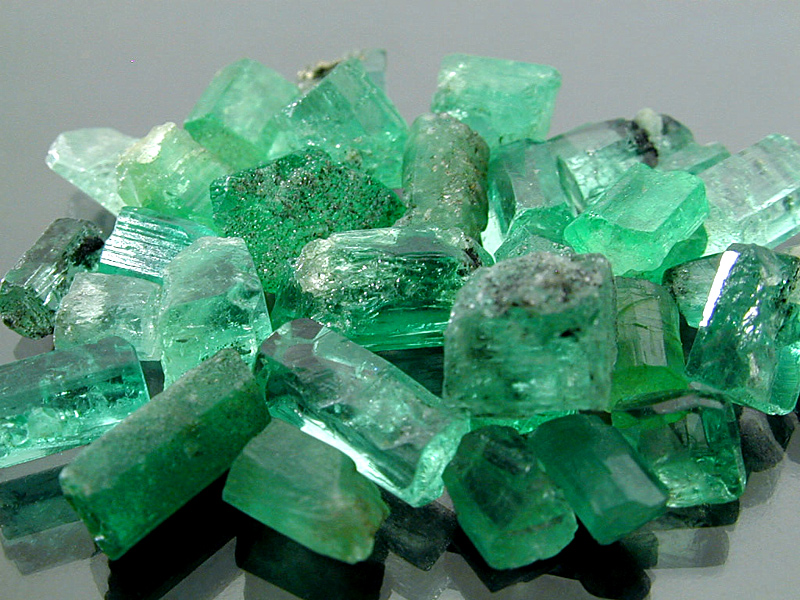
- Emerald is a well-known green mineral coloured by chromium.
What colour is Green?
Green sits between cyan and yellow in the visible spectrum and is seen in hundreds of shades. It is the colour most often linked with plants and nature, thanks to chlorophyll. In human vision, green is restful to the eye and is perceived when light with a wavelength of roughly 495–570 nm reaches us. Many animals and minerals also show green hues, sometimes for camouflage or due to chemical elements like chromium in emeralds.
Where does Green come from?
The English word 'green' comes from Old English 'grene', related to 'grass' and 'grow'. Similar roots appear in German ('grün'), Latin ('viridis'), and other European languages, all linked to fresh growth. The first use of 'green' as a colour word in English dates to around AD 700. In some languages, like old Chinese and Japanese, the same word covered both blue and green.
How Green is defined
Green is produced in different ways depending on the system. In painting and printing, it is made by mixing yellow and cyan. On screens, it is one of the three primary colours in the RGB model, mixed with red and blue to make other colours. In nature, green comes mainly from chlorophyll in plants. Many minerals, such as emerald, also appear green due to elements like chromium.


Where Green is used
Green is widely used in art, textiles, architecture, print, and on screens. It appears in famous paintings, national flags, uniforms, and public spaces such as the benches of the British House of Commons. It is also the traditional colour for safety signs and signals, like green traffic lights, and is used to indicate permission or environmental friendliness.
What Green means
Green is most often associated with nature, life, health, youth, spring, and hope in American, European, and Islamic countries. In Ireland and Gaelic culture, it is a historic symbol. In Islamic tradition, green stands for the lushness of Paradise and is found on many national flags. In China and much of Asia, green is linked to fertility and happiness. In the West, it can also suggest envy or, less commonly, toxicity.
Green around the world
What the green family means from country to country.
British racing green is the dark green of British motor racing cars. It dates from the early 1900s, when each country's cars raced in a national colour.
Festival and celebrationPrideSource: British racing greenGreen stands for Ireland itself, the Emerald Isle, and for Saint Patrick's shamrock. On 17 March people wear green and a sprig of shamrock.
Nature and renewalPolitics and protestPrideSource: Saint Patrick's DayThe green stripe of the flag stands for the older Gaelic and Catholic tradition. Green was the colour of the United Irishmen, whose 1798 rising is recalled in the song The Wearing of the Green.
Politics and protestCourageSource: Flag of IrelandA green kerchief is the sign of the campaign for legal abortion. Huge crowds wore it in 2018, and the movement was called the green wave.
Politics and protestHopeSource: Green scarfGreen and gold have been the official national colours since 1984 and are worn by national sports teams. They echo the leaves and flowers of the golden wattle.
Festival and celebrationPrideSource: National colours of AustraliaA Test cricketer is given a dark green cap, the baggy green, on first playing for Australia. Many players wear the same faded cap for a whole career.
Festival and celebrationPrideSource: Baggy greenShades and relatives of Green
Green covers a wide range of shades, from yellowish to bluish greens. In some languages, blue and green are not clearly separated, and terms can overlap. There are also many green pigments and minerals, such as emerald and chrome green, each with their own specific hue.
Colours that go with Green
Harmonies are worked out from the value #00FF00. Contrast ratios follow the WCAG 2 formula.
Questions people ask about Green
What colour is green?
Green is the colour between cyan and yellow on the visible spectrum, seen in plants and many minerals. It is produced by light with a wavelength of about 495–570 nm.
Where does the word 'green' come from?
The word 'green' comes from Old English 'grene', related to words for grass and growth. Similar roots appear in German, Latin, and other European languages.
How is green made in art and on screens?
In painting and printing, green is made by mixing yellow and cyan. On screens, it is one of the three primary colours in the RGB model, mixed with red and blue to create other colours.
What does green symbolise in different cultures?
Green is linked to nature, life, health, and hope in many cultures. In Ireland, it is a national symbol, and in Islam, it represents Paradise. In China and Asia, it stands for fertility and happiness.
Is green always a separate colour in all languages?
No, in some languages like old Chinese, Japanese, and Vietnamese, the same word can mean both blue and green, and only later did separate terms develop.
Good reading and sources
The facts on this page come from the Wikipedia article "Green", written by its contributors and used under the CC BY-SA 4.0 licence, and from its Wikidata record (CC0). Rang rewrote the text in its own words, with AI assistance, and compares every page with the article to make sure no passage is copied. It may be reused under the same CC BY-SA 4.0 licence with a link back.
It may contain mistakes. The swatch is an approximation: named colours are not fixed standards, and every screen shows them a little differently. If something is wrong, tell us. Last refreshed 2026-10-03.
More of the green family
All of green
#BFFF00
Lime
A sharp yellow-green named for the skin of the lime fruitNamed shade

#80FF00
Chartreuse
A bright yellow-green named after a French liqueurNamed shade
#00FF80
Spring green
A bright green halfway between green and cyan on the RGB colour wheelNamed shade

#228B22
Forest green
A deep green matching the leaves of temperate forestsNamed shade
#123524
Phthalo green
A synthetic green pigment made from copper and chlorinated phthalocyaninePigment
#3B7A57
Jungle green
A rich medium green named for the colour of dense rainforest foliageNamed shade · 🇺🇸 United States +1
#A7FC00
Spring bud
A bright yellow-green once known as spring green before 1987Named shade

Green
Go Away Green
A muted green paint used in Disney Parks to hide buildings and infrastructureNamed shade
More colours tied to Ireland
The colours of Ireland
#F4C430
Saffron
A yellow-orange shade named after the colour of saffron crocus threadsNamed shade · 🇮🇳 India +1

#4A412A
Pantone 448 C
A dull brown shade chosen to discourage smoking by making packaging unattractiveStandard colour · 🇦🇺 Australia +5

Red
Red hair
A rare human hair colour ranging from deep burgundy to strawberry blondNamed shade · 🇮🇪 Ireland +3

#A52A2A
Auburn hair
A natural hair colour blending red and brown tonesNamed shade · 🇳🇴 Norway +4