Brazilin
A red dye from brazilwood and sappanwood, used in textiles and paints since the Middle Ages
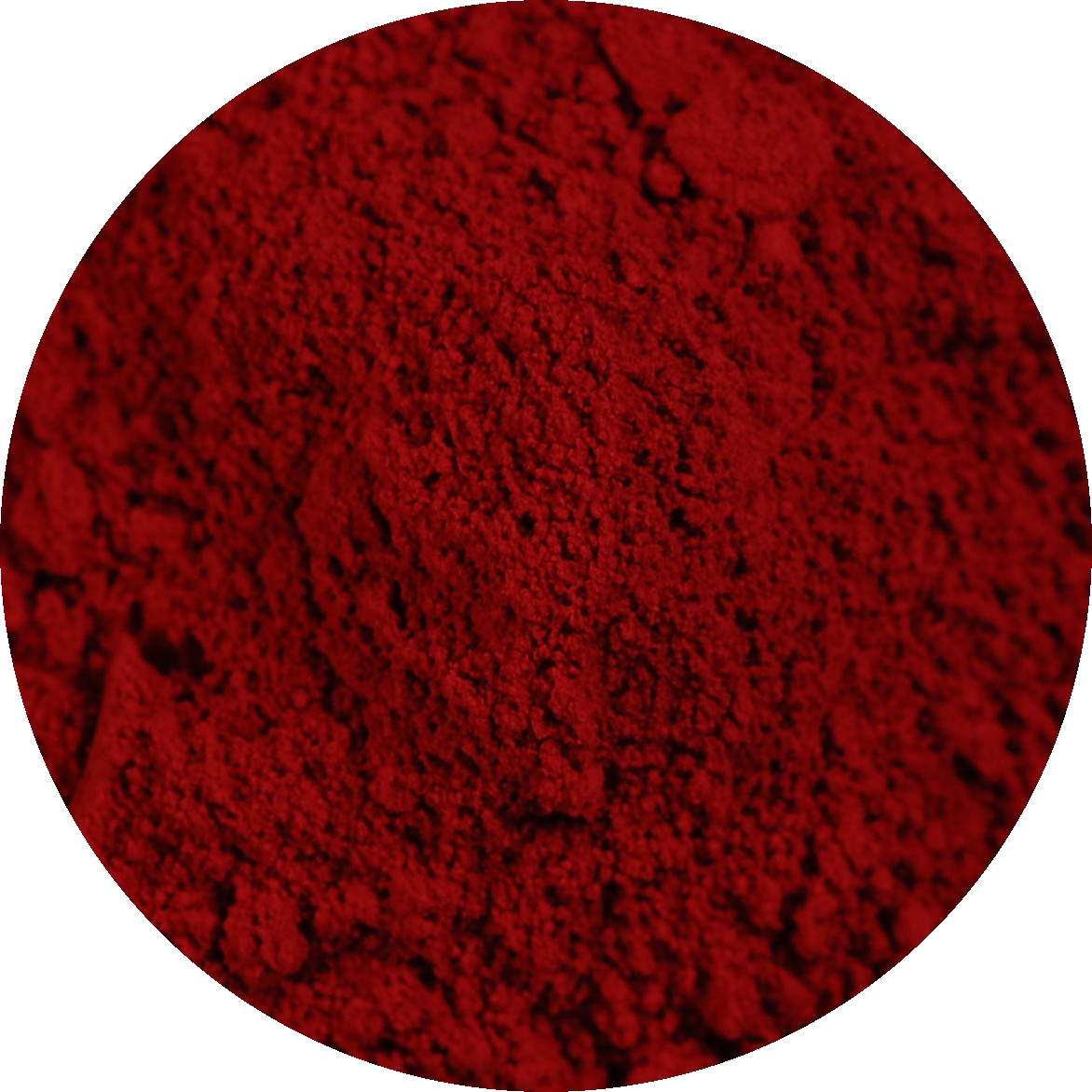
No single value: Brazilin is a material, and its colour varies. The background shows its family, red.
Brazilin is a natural red dye found in the wood of brazilwood and sappanwood trees. Its colour shifts from yellow in acid to red in alkaline, and it has coloured fabrics, inks, and paints since at least the Middle Ages. The dye is made by extracting pigment from the wood, and its exact shade depends on how it is prepared.
- Extracted from brazilwood and sappanwood trees
- Used as a red dye since the Middle Ages
- Colour shifts from yellow (acid) to red (alkaline)
- Brazilwood is now endangered due to overuse
- Also used to stain cell nuclei red in histology
What colour is Brazilin?
Brazilin is a natural dye that produces a red colour, though its exact shade can change depending on how it is prepared. When mixed with acid it appears yellow, but in alkaline conditions it turns red. The dye is extracted from several types of wood, most notably brazilwood and sappanwood. Brazilin stands out because it can create a range of reds and oranges, and is used both as a dye for textiles and as a pigment in paints and inks.
Where does Brazilin come from?
The dye comes from the heartwood of trees such as Paubrasilia echinata (brazilwood) and Biancaea sappan (sappanwood). Sappanwood was once a major export from Sri Lanka to Europe in the early Middle Ages. After brazilwood was discovered in South America, it became the main source for the dye, leading to its overuse and the tree's endangered status. The name 'brazilin' is linked to these trees.
How is Brazilin made?
To make brazilin dye, the wood is first powdered. The powder is then soaked in lye for a deep purplish red, or in hot alum solution for an orange-red. Adding alum to lye extract or lye to alum extract helps fix the colour, which is then collected as a precipitate. This can be dried and powdered to make a lake pigment. The colour produced depends on the pH and the fixative used. For transparent inks or paints, the powder is soaked in glair or gum arabic, with alum added to fix the colour.
Where Brazilin is used
Brazilin has been used for centuries to dye fabrics and to make paints and inks. In the Middle Ages, it was a popular textile dye in Europe. It is also used in histology, where it stains cell nuclei red when combined with aluminium. The dye's colour can be adjusted for different uses by changing the preparation method or mordant.
Red around the world
What the red family means from country to country.
Red is the colour of the Workers' Party, founded in 1980, whose symbol is a red star. Its rallies are a sea of red shirts and flags.
Politics and protestSource: Workers' Party (Brazil)The flag is called Sang Saka Merah Putih, the Red and White. Red is commonly read as courage and white as purity. It was raised at the declaration of independence in 1945.
Politics and protestCouragePrideSource: Flag of IndonesiaMany Hindu brides marry in a red sari or lehenga. In much of north India a married woman wears sindoor, a red powder, along the parting of her hair.
Weddings and marriageLuck and prosperityJoyLoveSource: SindoorThe national flag sets a gold lion on a maroon panel, which stands for the Sinhalese majority. Four bo leaves in the corners are for the Buddhist virtues of kindness, compassion, joy and equanimity.
Politics and protestSource: Flag of Sri LankaRed is the colour of the left, above all the Janatha Vimukthi Peramuna, whose supporters march in red on May Day.
Politics and protestSource: Janatha Vimukthi PeramunaThe flag uses the four Pan-Arab colours: a red bar at the hoist with green, white and black bands. It was designed by a young Emirati, Abdullah Al Maainah, in 1971.
Politics and protestPrideSource: Flag of the United Arab EmiratesShades and relatives of Brazilin
Brazilin is closely related to hematoxylin, a blue-black dye precursor, but has one fewer hydroxyl group. Its oxidised form, brazilein, is the active dye agent. The dye can appear yellow, orange-red, or purplish red depending on the pH and mordants used, and is sometimes confused with other natural red dyes.
Questions people ask about Brazilin
What colour is brazilin?
Brazilin produces a red dye, but can also appear yellow in acidic solutions and red in alkaline ones. The exact shade depends on how it is prepared and the mordants used.
Where does the name brazilin come from?
The name comes from the brazilwood tree, one of the main sources of the dye. The dye is also found in sappanwood and related species.
How is brazilin made?
Brazilin is made by powdering the wood of certain trees, then extracting the dye with lye or alum solutions. The colour is fixed and collected as a precipitate, which can be dried and used as a pigment.
What is brazilin used for?
It is used to dye textiles, and to make paints and inks. It is also used in histology to stain cell nuclei red.
Is brazilwood still used for brazilin?
Brazilwood was widely used, but over-exploitation has made it endangered. Sappanwood and other species are also sources of brazilin.
Good reading and sources
The facts on this page come from the Wikipedia article "Brazilin", written by its contributors and used under the CC BY-SA 4.0 licence, and from its Wikidata record (CC0). Rang rewrote the text in its own words, with AI assistance, and compares every page with the article to make sure no passage is copied. It may be reused under the same CC BY-SA 4.0 licence with a link back.
It may contain mistakes. The swatch is an approximation: named colours are not fixed standards, and every screen shows them a little differently. If something is wrong, tell us. Last refreshed 2026-10-03.
More of the red family
All of red
Red
Cinnabar
A scarlet to brick-red mineral and the main source of mercury and vermilion pigmentColour named from nature · 🇪🇸 Spain +5

Red
Realgar
An orange-red arsenic sulfide mineral once used as a pigment and poisonPigment · 🇨🇳 China +5

#E25822
Scarlet
A bright red with a touch of orange, long tied to power, sacrifice and sinNamed shade · 🇹🇷 Turkey +4
Red
Carmine
A deep red pigment made from cochineal insects, once prized across continentsPigment · 🇫🇷 France +2

Red
Rubia
A group of plants whose roots once dyed cloth and paint a lasting redColour named from nature · 🇪🇬 Egypt +5

#E34234
Vermilion
A brilliant orange-red pigment, once made from toxic mercury orePigment · 🇹🇷 Turkey +5

#DC143C
Crimson
A deep red with a hint of purple, once made from insectsNamed shade · 🇳🇵 Nepal

#E32636
Alizarin
A deep red dye first made from madder roots, later produced from coal tarDye · 🇹🇷 Turkey +1
More colours tied to Brazil
The colours of Brazil
Orange
Annatto
A yellow-orange dye and flavour from the seeds of the achiote treeDye · 🇲🇽 Mexico +5

#86A1A9
Tourmalineටෝරමල්ලි
A mineral group prized for its rainbow of gemstone coloursColour named from nature · 🇱🇰 Sri Lanka +5
Black
Onyx
A banded stone, usually black and white, prized for carving and jewelleryColour named from nature · 🇲🇽 Mexico +5

Green
Glauconite
A soft green mineral used as a pigment and in fertilisersColour named from nature · 🇧🇷 Brazil +2