Carthamin
A red pigment and dye obtained from safflower flowers
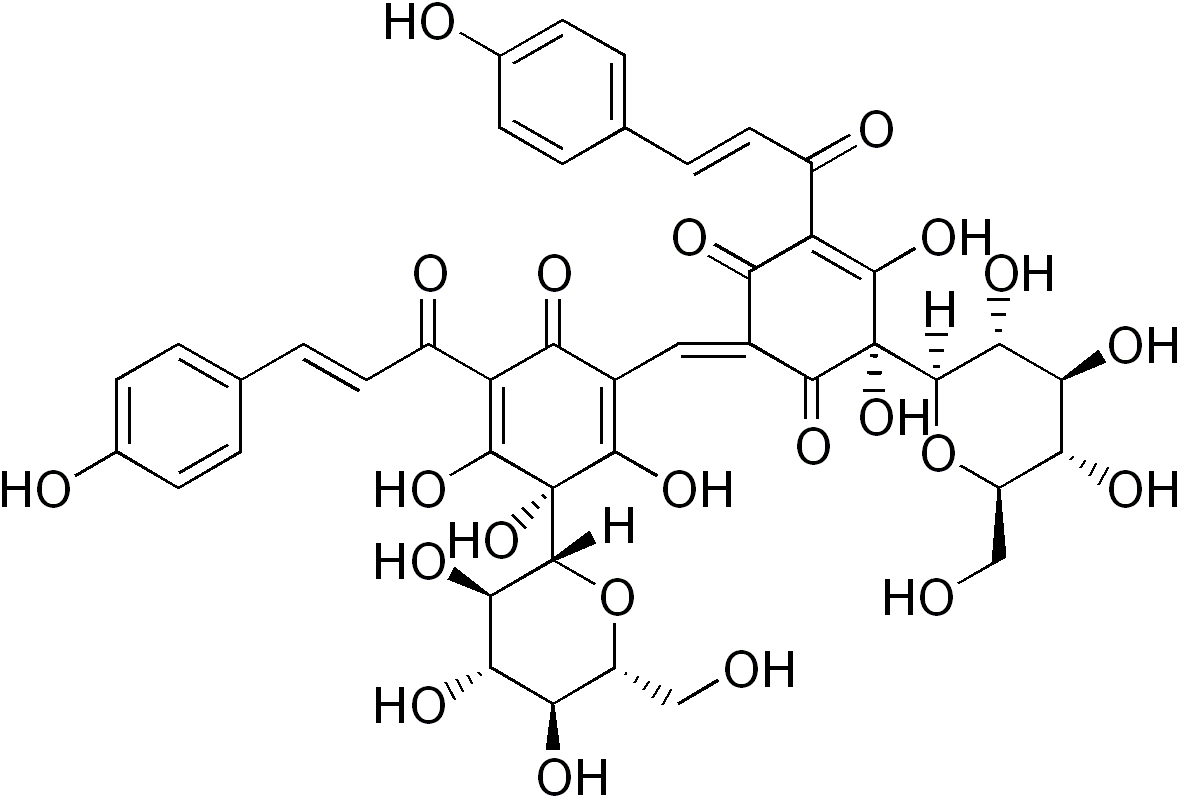
Carthamin is a red colouring substance taken from the safflower plant. It has been used to dye fabrics and as a food colourant, especially in Japan and Egypt. The pigment is known for its use in silk and wool and is called 'beni' in Japanese textiles and cosmetics.
Share on WhatsAppOpen in the lab
- Carthamin is a red dye from safflower petals
- Known as 'beni' in Japanese textiles and cosmetics
- Used as a food colouring called Natural Red 26
- Once important for dyeing silk and wool
- Sometimes mixed with turmeric or sappan in Japan
What colour is Carthamin?
Carthamin is a bright red pigment that comes from the petals of the safflower plant. It stands out from other reds by its plant origin and its use in both dyeing and food colouring. The colour is vivid and was especially valued for dyeing silk and wool, as well as for use in cosmetics.
Where does Carthamin come from?
The name carthamin comes from the safflower plant, Carthamus tinctorius, which is the source of this pigment. Its use as a dye goes back to early Egypt, and it became important in Japan, where it is called 'beni'. Over time, it was also used in Europe for wool and carpets.
How is Carthamin made?
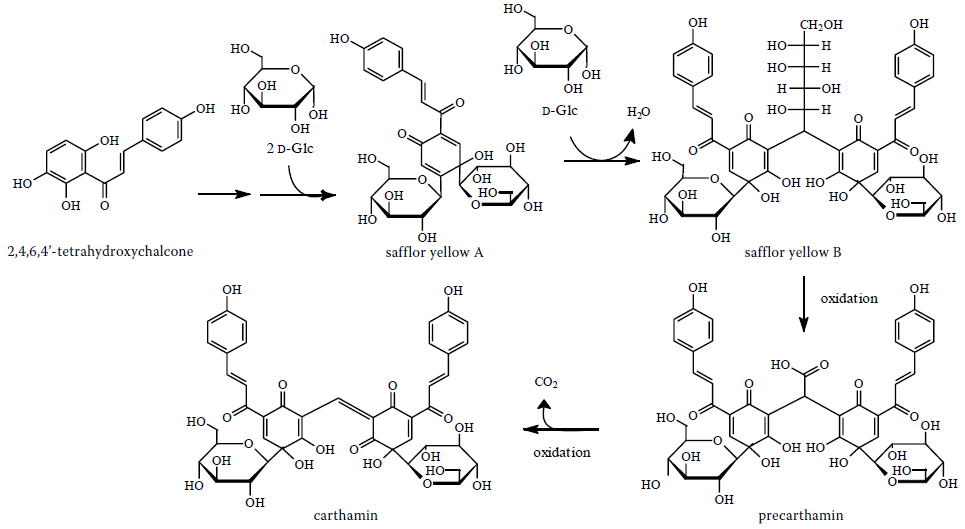
Carthamin is extracted from safflower flowers. The pigment forms through a series of steps in the plant, starting from a type of molecule called a chalcone, which combines with glucose to make yellow compounds, then changes further to become the red carthamin.
Where Carthamin is used
Carthamin was once widely used to dye wool for carpets in Europe and silk in Japan. In Japan, it was also used in cosmetics. Because it was costly to produce, Japanese dyers sometimes mixed it with other dyes. Today, it is known as Natural Red 26 when used as a food colouring.
Red around the world
What the red family means from country to country.
The ancient Egyptians called the desert deshret, the red land. Red was the colour of the god Set, of chaos and of danger, and scribes wrote unlucky words in red ink.
Danger and warningFearSource: RedThe flag is red, white and black. Red recalls the struggle before the 1952 revolution, white the revolution itself, which was nearly bloodless, and black the end of oppression.
Politics and protestPrideSource: Flag of EgyptThe torii gates of Shinto shrines are often painted vermilion, a bright orange-red. The colour is held to keep evil away, and the long tunnels of gates at Fushimi Inari are the best known.
Sacred and holyProtection and healingAweSource: ToriiThe flag uses the four Pan-Arab colours: a red bar at the hoist with green, white and black bands. It was designed by a young Emirati, Abdullah Al Maainah, in 1971.
Politics and protestPrideSource: Flag of the United Arab EmiratesThe flag is a black double-headed eagle on red, the banner of the fifteenth-century hero Skanderbeg. Fans chant Kuq e Zi, red and black.
Politics and protestPrideSource: Flag of AlbaniaArmenian scribes painted manuscripts with vordan karmir, a crimson dye made from an insect that lives on the roots of grasses in the Ararat plain.
Sacred and holySource: Armenian cochinealShades and relatives of Carthamin
Carthamin should not be mistaken for carthamidin, which is a different flavonoid from safflower. In Japan, the same pigment is called 'beni'. The colour may have been mixed with other dyes such as turmeric or sappan to stretch its use.
Colours that go with Carthamin
Harmonies are worked out from the value #D71345. Contrast ratios follow the WCAG 2 formula.
Questions people ask about Carthamin
What colour is carthamin?
Carthamin is a bright red pigment obtained from the petals of the safflower plant.
Where does the name carthamin come from?
The name comes from the safflower plant, Carthamus tinctorius, which is the source of the pigment.
What was carthamin used for?
It was used to dye wool and silk, especially in Europe and Japan, and in Japanese cosmetics. It is also used as a food colouring.
Is carthamin the same as carthamidin?
No, carthamin and carthamidin are different substances, both found in safflower but with different properties.
Good reading and sources
The facts on this page come from the Wikipedia article "Carthamin", written by its contributors and used under the CC BY-SA 4.0 licence, and from its Wikidata record (CC0). EveryRang rewrote the text in its own words, with AI assistance, and compares every page with the article to make sure no passage is copied. It may be reused under the same CC BY-SA 4.0 licence with a link back.
It may contain mistakes. The swatch is an approximation: named colours are not fixed standards, and every screen shows them a little differently. If something is wrong, tell us. Last refreshed 2026-10-03.
More of the red family
All of red
Red
Cinnabar
A scarlet to brick-red mineral and the main source of mercury and vermilion pigmentColour named from nature · 🇪🇸 Spain +5

Red
Realgar
An orange-red arsenic sulfide mineral once used as a pigment and poisonPigment · 🇨🇳 China +5
Red
Carmine
A deep red pigment made from cochineal insects, once prized across continentsPigment · 🇫🇷 France +2

#E25822
Scarlet
A bright red with a touch of orange, long tied to power, sacrifice and sinNamed shade · 🇹🇷 Turkey +4

#E34234
Vermilion
A brilliant orange-red pigment, once made from toxic mercury orePigment · 🇹🇷 Turkey +5

Red
Rubia
A group of plants whose roots once dyed cloth and paint a lasting redColour named from nature · 🇪🇬 Egypt +5

#E32636
Alizarin
A deep red dye first made from madder roots, later produced from coal tarDye · 🇹🇷 Turkey +1

#801818
Falu redfalu rödfärg
A deep red paint pigment from the Falun copper mine, used on wooden houses in SwedenPigment · 🇸🇪 Sweden +2
More colours tied to Egypt
The colours of Egypt
#FF0000
Red
A long wavelength of light linked to blood, luck, and revolution.Basic colour · 🇪🇬 Egypt +5

#FFFF00
Yellow
A bright spectral shade found in sunlight, autumn foliage, and ancient earth pigments.Colour named from nature · 🇫🇷 France +5

#0000FF
Blue
The spectral hue of clear daylight skies and deep waterBasic colour · 🇪🇬 Egypt +4

#FFFFFF
White
The lightest colour, seen in snow, milk and chalk, and opposite to blackBasic colour · 🇪🇬 Egypt +5