Red 2G
A synthetic red azo dye once used in food and inks, now banned in many countries
No single value: Red 2G is a material, and its colour varies. The background shows its family, red.
Red 2G is a man-made red dye that dissolves in water and was once used to colour certain foods and papers. It is made by joining two chemical compounds under basic conditions and was known as E128 in the European Union, where it was mainly added to some sausages and burger meats. Safety concerns led to its ban in the EU and several other countries.
- Red 2G was known as E128 in the EU
- Banned in the EU, Australia, Canada, Japan, Norway, Malaysia, and Israel
- It can turn into toxic aniline in the body
- Used for colouring foods, inks, and paper
- Made by azo coupling of Acetyl-H acid and aniline
What colour is Red 2G?
Red 2G is a synthetic dye that gives a strong red colour. It is made in laboratories and dissolves well in water, but only a little in glycerol. It is usually found as a disodium salt, which means it is combined with sodium to help it dissolve. Its red shade was used to colour foods and also in inks and papers.
Where does Red 2G come from?
The name Red 2G comes from its use as a food dye and its place in the European food additive system, where it was called E128. It is an azo dye, a group of synthetic colours made by joining two chemical parts together. Red 2G was used in Europe and other countries until safety concerns led to its ban.
How is Red 2G made?
Red 2G is produced by a chemical process called azo coupling. This involves reacting Acetyl-H acid with a diazonium compound made from aniline, under basic (alkaline) conditions. The result is a red dye that is usually turned into a disodium salt to make it easier to use in water-based products.
Where Red 2G is used
Red 2G was mainly used as a food colouring, especially in certain sausages and burger meats in the European Union. It was also used to dye coatings, inks, paper, crepe paper, and fine tissue. In science, it has been used for staining in histology, though this is rare.
Red around the world
What the red family means from country to country.
Red ochre is used in Aboriginal rock art and ceremony, and is traded over long distances. In the Aboriginal flag the red half stands for the earth and for that ochre.
Sacred and holyNature and renewalAweSource: Australian Aboriginal flagRed and white are the national colours. The flag, a red maple leaf between two red bars, was adopted in 1965 after a long debate in parliament.
Politics and protestPrideSource: National colours of CanadaOfficers of the Royal Canadian Mounted Police wear the Red Serge, a scarlet tunic with a high collar, on ceremonial duty. It is one of the best known images of the country abroad.
Protection and healingTrustSource: Red SergeEmpty red dresses hung in public places stand for missing and murdered Indigenous women and girls. The idea comes from the REDress Project by the Metis artist Jaime Black.
Mourning and deathProtection and healingGriefSource: REDress ProjectThe torii gates of Shinto shrines are often painted vermilion, a bright orange-red. The colour is held to keep evil away, and the long tunnels of gates at Fushimi Inari are the best known.
Sacred and holyProtection and healingAweSource: ToriiThe flag is red with a blue cross edged in white. The colours were chosen in 1821 to echo the flags of free countries such as France and the United States.
Politics and protestPrideSource: Flag of NorwayShades and relatives of Red 2G
Red 2G is part of the azo dye family, which includes many other synthetic reds and oranges. It is sometimes called (EZ)-azophloxine. Its use is now restricted or banned in many places due to health concerns, so it is not commonly seen in foods or products today.
Questions people ask about Red 2G
What colour is Red 2G?
Red 2G is a synthetic dye that produces a strong red colour, often used to colour foods and papers.
Where does the name Red 2G come from?
The name Red 2G comes from its use as a food dye and its code E128 in the European food additive system.
Why was Red 2G banned?
Red 2G was banned because it can be converted in the body to aniline, a toxic compound that may interfere with blood haemoglobin and is suspected of causing cancer.
What was Red 2G used for?
It was used to colour certain foods, especially sausages and burger meats, and also in inks, coatings, and paper.
How is Red 2G made?
Red 2G is made by a chemical process called azo coupling, joining Acetyl-H acid and a diazonium derivative of aniline under basic conditions.
Good reading and sources
The facts on this page come from the Wikipedia article "Red 2G", written by its contributors and used under the CC BY-SA 4.0 licence, and from its Wikidata record (CC0). Rang rewrote the text in its own words, with AI assistance, and compares every page with the article to make sure no passage is copied. It may be reused under the same CC BY-SA 4.0 licence with a link back.
It may contain mistakes. The swatch is an approximation: named colours are not fixed standards, and every screen shows them a little differently. If something is wrong, tell us. Last refreshed 2026-10-03.
More of the red family
All of red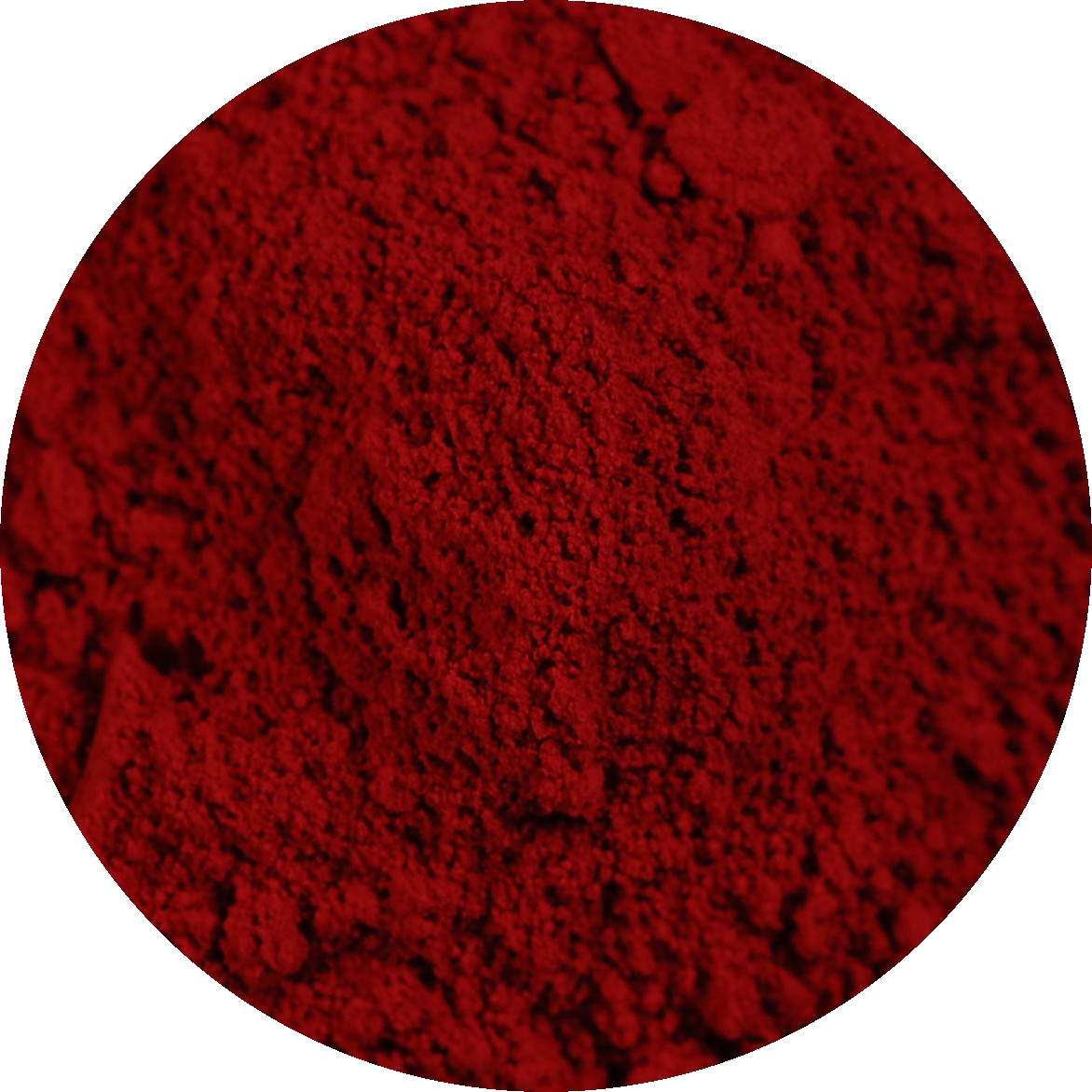
Red
Carmine
A deep red pigment made from cochineal insects, once prized across continentsPigment · 🇫🇷 France +2

Red
Rubia
A group of plants whose roots once dyed cloth and paint a lasting redColour named from nature · 🇪🇬 Egypt +5

#E32636
Alizarin
A deep red dye first made from madder roots, later produced from coal tarDye · 🇹🇷 Turkey +1

Red
Hennaحِنَّاء
A reddish dye from the henna plant, used for body art and hair since ancient timesColour named from nature · 🇪🇬 Egypt +5

Red
Kumkum
A red powder made from turmeric and lime, used for forehead marks in IndiaDye · 🇮🇳 India

Red
Kermes
A deep red dye made from Mediterranean scale insects, once prized for scarlet clothDye · 🇪🇬 Egypt +5
Red
Brazilin
A red dye from brazilwood and sappanwood, used in textiles and paints since the Middle AgesDye · 🇧🇷 Brazil +4

Red
Lacलाक्षा
A red resin secreted by insects and used as dye, varnish and shellacColour named from nature · 🇮🇳 India +5
More colours tied to Australia
The colours of Australia
#CC7722
Ochre
A natural earth pigment ranging from yellow to deep orange or brownPigment · 🇦🇺 Australia +5

#87CEEB
Sky blue
A light blue named for the colour of a clear daytime skyNamed shade · 🇦🇷 Argentina +5

#800000
Maroon
A deep brownish red named for the French word for chestnutNamed shade · 🇦🇺 Australia +4

#000080
Navy blue
A deep blue shade named for the uniforms of the Royal NavyNamed shade · 🇺🇸 United States +2