Lead(II,IV) oxide
A strong red-orange pigment once widely used to protect iron and in illuminated manuscripts
No single value: Lead(II,IV) oxide is a material, and its colour varies. The background shows its family, red.
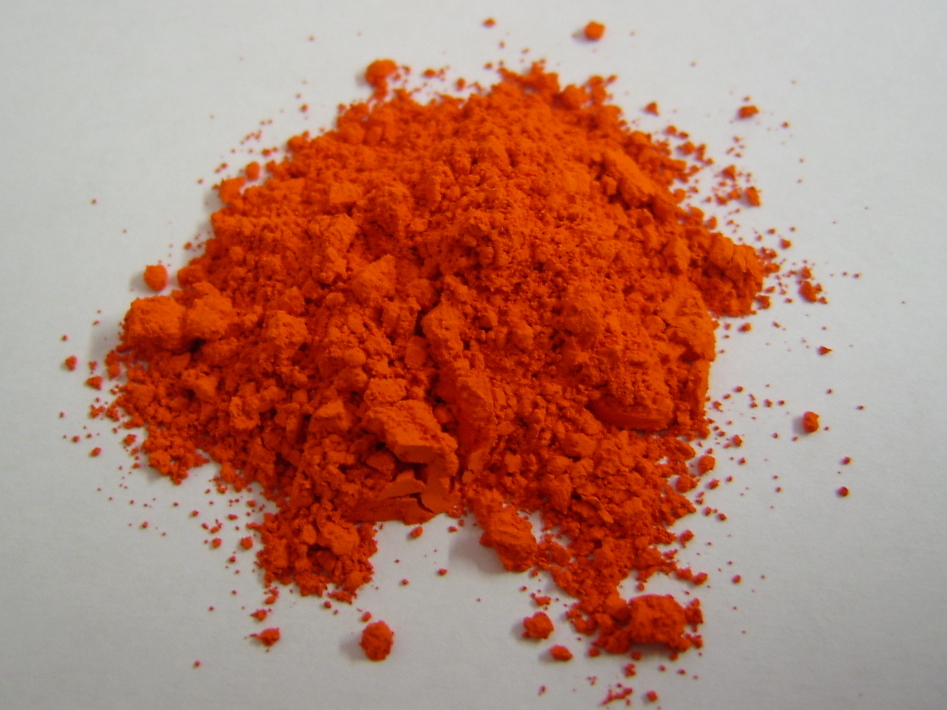
Lead(II,IV) oxide is a vivid red or orange solid, known as red lead or minium. Its name comes from the Latin for a river in Iberia where it was first found. This compound has served as a pigment in paints, especially for ironwork, and in medieval manuscript art. Its use is now restricted due to its toxicity.
- Known as red lead or minium
- Used in ancient Roman and medieval art
- Protects iron from rust when used in paint
- Toxic and now restricted in many uses
- Rare natural samples found at Broken Hill, Australia
What colour is Lead(II,IV) oxide?
Lead(II,IV) oxide is a bright red to orange powder, often called red lead or minium. It stands out for its strong, warm colour and has been valued for its ability to protect iron from rust. The colour is intense and opaque, making it useful for both painting and industrial coatings.
Where does Lead(II,IV) oxide come from?
The name minium comes from the Latin for a river in northwestern Iberia, reflecting where the material was first sourced. People in ancient Rome made it by heating white lead, and it became a staple pigment for artists and scribes. Its use in illuminated manuscripts even gave rise to the word 'miniature' for small, detailed paintings.
How is Lead(II,IV) oxide made?
Industrially, lead(II,IV) oxide is produced by heating lead(II) oxide in air at high temperatures. It can also be made by heating lead carbonate or white lead. In rare cases, it forms naturally in oxidised lead ore deposits, such as those found at Broken Hill in Australia. The process yields a powder that is then purified for use.

Where Lead(II,IV) oxide is used
Red lead has been used in paints to protect iron structures and as a pigment in manuscript art. It was also used in early fireworks and as a marking compound in engineering. Its role as a primer for ironwork was especially important before safer alternatives were developed. In some traditional medicines, it was used despite its risks.
Red around the world
What the red family means from country to country.
Red ochre is used in Aboriginal rock art and ceremony, and is traded over long distances. In the Aboriginal flag the red half stands for the earth and for that ochre.
Sacred and holyNature and renewalAweSource: Australian Aboriginal flagThe flag uses the four Pan-Arab colours: a red bar at the hoist with green, white and black bands. It was designed by a young Emirati, Abdullah Al Maainah, in 1971.
Politics and protestPrideSource: Flag of the United Arab EmiratesThe flag is a black double-headed eagle on red, the banner of the fifteenth-century hero Skanderbeg. Fans chant Kuq e Zi, red and black.
Politics and protestPrideSource: Flag of AlbaniaArmenian scribes painted manuscripts with vordan karmir, a crimson dye made from an insect that lives on the roots of grasses in the Ararat plain.
Sacred and holySource: Armenian cochinealUnder Juan Manuel de Rosas in the 1830s and 1840s, everyone had to wear a scarlet ribbon to show loyalty to his Federalist party. His enemies, the Unitarians, were tied to sky blue.
Politics and protestFearSource: Juan Manuel de RosasThe flag is red, white and red. Legend says Duke Leopold V's white tunic was soaked in blood at the siege of Acre, all but the band under his belt.
Politics and protestCourageSource: Flag of AustriaShades and relatives of Lead(II,IV) oxide
Other lead oxides, such as lead(II) oxide and lead(IV) oxide, are related but differ in colour and use. Red lead is sometimes confused with these, but its distinct red-orange hue and mixed-valence chemistry set it apart. The term minium can refer to both the mineral and the pigment.
Questions people ask about Lead(II,IV) oxide
What colour is lead(II,IV) oxide?
It is a vivid red or orange solid, often described as bright red lead or minium.
Where does the name minium come from?
Minium comes from the Latin name for a river in northwestern Iberia, where the pigment was first obtained.
How is red lead made?
It is produced by heating lead(II) oxide or lead carbonate in air, or by heating white lead. Rarely, it forms naturally in oxidised lead ore.
What was red lead used for?
It was used as a pigment in paints for protecting iron, in illuminated manuscripts, and in some traditional medicines and fireworks.
Is lead(II,IV) oxide safe?
No, it is toxic if inhaled, ingested, or absorbed through the skin, and can cause lead poisoning. Its use is now limited for safety reasons.
Good reading and sources
- Lead(II,IV) oxide on WikipediaEncyclopedia
- More pictures on Wikimedia CommonsPictures
- Wikidata recordOpen data
The facts on this page come from the Wikipedia article "Lead(II,IV) oxide", written by its contributors and used under the CC BY-SA 4.0 licence, and from its Wikidata record (CC0). Rang rewrote the text in its own words, with AI assistance, and compares every page with the article to make sure no passage is copied. It may be reused under the same CC BY-SA 4.0 licence with a link back.
It may contain mistakes. The swatch is an approximation: named colours are not fixed standards, and every screen shows them a little differently. If something is wrong, tell us. Last refreshed 2026-10-03.
More of the red family
All of red
Red
Cinnabar
A scarlet to brick-red mineral and the main source of mercury and vermilion pigmentColour named from nature · 🇪🇸 Spain +5

Red
Realgar
An orange-red arsenic sulfide mineral once used as a pigment and poisonPigment · 🇨🇳 China +5
Red
Carmine
A deep red pigment made from cochineal insects, once prized across continentsPigment · 🇫🇷 France +2

#E25822
Scarlet
A bright red with a touch of orange, long tied to power, sacrifice and sinNamed shade · 🇹🇷 Turkey +4

#E34234
Vermilion
A brilliant orange-red pigment, once made from toxic mercury orePigment · 🇹🇷 Turkey +5

Red
Rubia
A group of plants whose roots once dyed cloth and paint a lasting redColour named from nature · 🇪🇬 Egypt +5

#DC143C
Crimson
A deep red with a hint of purple, once made from insectsNamed shade · 🇳🇵 Nepal

#E32636
Alizarin
A deep red dye first made from madder roots, later produced from coal tarDye · 🇹🇷 Turkey +1
More colours tied to Australia
The colours of Australia
#CC7722
Ochre
A natural earth pigment ranging from yellow to deep orange or brownPigment · 🇦🇺 Australia +5

#87CEEB
Sky blue
A light blue named for the colour of a clear daytime skyNamed shade · 🇦🇷 Argentina +5

#800000
Maroon
A deep brownish red named for the French word for chestnutNamed shade · 🇦🇺 Australia +4

#000080
Navy blue
A deep blue shade named for the uniforms of the Royal NavyNamed shade · 🇺🇸 United States +2