Minium
A bright orange-red pigment made by heating lead, once common in medieval manuscripts

Minium is a vivid orange-red pigment created by heating lead compounds in air. It was widely used in medieval Europe for decorating manuscripts, and also found in art and cosmetics in China, India, Japan, and the ancient Mediterranean. Known for its strong colour and hiding power, it is poisonous and can darken over time.
Share on WhatsAppOpen in the lab
- Minium was widely used for medieval manuscript decoration.
- Its name comes from the river Miño/Minho on the Iberian border.
- It is made by roasting white lead in air.
- The pigment can darken over time, especially in damp or light-exposed places.
- Minium is poisonous and should be handled with care.
What colour is Minium?
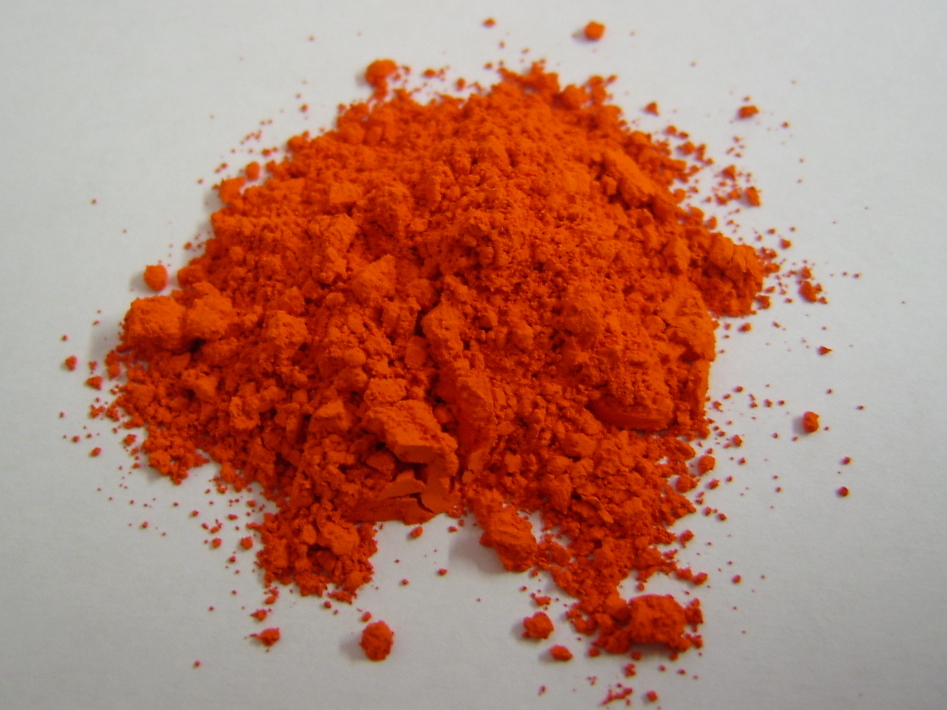
Minium is a pigment with a strong orange-red colour, more orange than its name suggests. It stands out for its brightness and density, making it useful for covering surfaces completely. The shade can shift depending on how long it is heated and the size of its particles. Minium is often confused with other red pigments like cinnabar and vermilion, but it is distinct for being made from lead and for its tendency to darken over time.
Where does Minium come from?
The name minium comes from the river Minius, now called Miño or Minho, on the border between Spain and Portugal, near ancient cinnabar mines. In Roman times, the word referred to both red lead and ground cinnabar, which led to confusion. Minium made from lead was cheaper and easier to produce than cinnabar, so it became the most used bright red pigment in medieval Europe. It was known in China as early as 300 BC and described in Chinese texts by the 5th century.
How is Minium made?
Minium is produced by heating white lead pigment in air. As it is roasted, the white lead first turns yellow, then becomes orange as it changes into lead tetroxide. The final colour depends on how long it is heated and the conditions during roasting. The pigment is a fine powder with high density, giving it strong covering power in oil paints.
Where Minium is used
This pigment was a favourite for decorating medieval manuscripts, especially for drawing capitals, headings, and small illustrations called miniatures. It was also used in Persian and Indian miniature paintings, and in Japanese Ukiyo-e paintings, where it has often stayed bright because the scrolls were kept rolled up. Minium was applied as a cosmetic in ancient cultures and used for inscriptions on gold and marble. In modern times, it has been used in protective paints for metal surfaces, especially in Russia, Norway, India, and China.
Orange around the world
What the orange family means from country to country.
Saffron is the colour of renunciation, worn by Hindu sadhus, holy men who have given up worldly life. The top band of the national flag is saffron, which stands for strength and courage.
Sacred and holyPolitics and protestCourageSource: Saffron (color)The ribbon of Saint George has black and orange stripes. It comes from a Tsarist military order and is worn each 9 May, Victory Day.
Politics and protestPrideSource: Ribbon of Saint GeorgeThe lowest band of the flag is orange, often called apricot, after the national fruit. The constitution says it stands for the creative talent and hard work of the people.
Politics and protestNature and renewalPrideSource: Flag of ArmeniaThe flag is split corner to corner. The orange half stands for the Buddhist tradition, and the white dragon across the middle for purity.
Sacred and holySource: Flag of BhutanOn 30 September people wear orange shirts to remember the children sent to residential schools. Phyllis Webstad's new orange shirt was taken from her on her first day at one.
Mourning and deathPolitics and protestGriefSource: National Day for Truth and ReconciliationOrange is also the colour of the New Democratic Party. Its sweep of Quebec seats in the 2011 election was called the Orange Wave.
Politics and protestSource: New Democratic PartyShades and relatives of Minium
Minium is sometimes mistaken for cinnabar or vermilion, which are also red pigments but made from mercury rather than lead. Its colour can range from orange to red depending on how it is prepared. In some cases, it can darken to brown or black, especially in watercolour or on walls, due to chemical changes.
Colours that go with Minium
Harmonies are worked out from the value #FF4203. Contrast ratios follow the WCAG 2 formula.
Questions people ask about Minium
What colour is minium?
Minium is a strong orange-red pigment, usually appearing more orange than pure red. Its exact shade can vary depending on how it is made.
Where does the name minium come from?
The name comes from the river Minius, now known as Miño or Minho, which runs along the border of Spain and Portugal near old cinnabar mines.
How is minium made?
It is produced by heating white lead pigment in air until it turns first yellow, then orange, forming lead tetroxide.
What was minium used for?
Minium was used to decorate manuscripts, in miniature paintings, as a cosmetic, and to protect metal surfaces from rust.
Is minium safe to use?
No, minium is poisonous because it contains lead. It should be handled with caution and is not safe for use in cosmetics today.
Good reading and sources
- Minium (pigment) on WikipediaEncyclopedia
- More pictures on Wikimedia CommonsPictures
- Wikidata recordOpen data
The facts on this page come from the Wikipedia article "Minium (pigment)", written by its contributors and used under the CC BY-SA 4.0 licence, and from its Wikidata record (CC0). Rang rewrote the text in its own words, with AI assistance, and compares every page with the article to make sure no passage is copied. It may be reused under the same CC BY-SA 4.0 licence with a link back.
It may contain mistakes. The swatch is an approximation: named colours are not fixed standards, and every screen shows them a little differently. If something is wrong, tell us. Last refreshed 2026-10-03.
More of the orange family
All of orange
#CC7722
Ochre
A natural earth pigment ranging from yellow to deep orange or brownPigment · 🇦🇺 Australia +5

Orange
Annatto
A yellow-orange dye and flavour from the seeds of the achiote treeDye · 🇲🇽 Mexico +5

#F4C430
Saffron
A yellow-orange shade named after the colour of saffron crocus threadsNamed shade · 🇮🇳 India +1

#E73501
Chrome orange
A yellowish to deep orange pigment once prized by 19th-century paintersPigment
Orange
Tenné
A rare heraldic stain of orange-tawny, named for tanned leatherNamed shade · 🇫🇷 France +3

Orange
Perinone
A group of organic pigments with orange and red isomersPigment
Orange
Flexirubin
A yellow-orange pigment found in certain bacteriaPigment
Orange
Pigment Orange 36
A synthetic orange pigment valued for its lasting colour in paints and coatingsPigment
More colours tied to China
The colours of China
#FF0000
Red
A primary colour seen in light, pigment, and tradition worldwideBasic colour · 🇺🇸 United States +5

#FFFF00
Yellow
A primary colour between green and orange, seen in sunlight, leaves, and pigmentsBasic colour · 🇫🇷 France +5

#800080
Purple
A cool colour between red and blue, long linked with royalty and rarityBasic colour · 🇱🇧 Lebanon +5

Red
Cinnabar
A scarlet to brick-red mineral and the main source of mercury and vermilion pigmentColour named from nature · 🇪🇸 Spain +5