Chrysothrix chlorina
A yellow to yellow-green powdery lichen used as a dye in India and Sweden
No single value: Chrysothrix chlorina is a material, and its colour varies. The background shows its family, yellow.
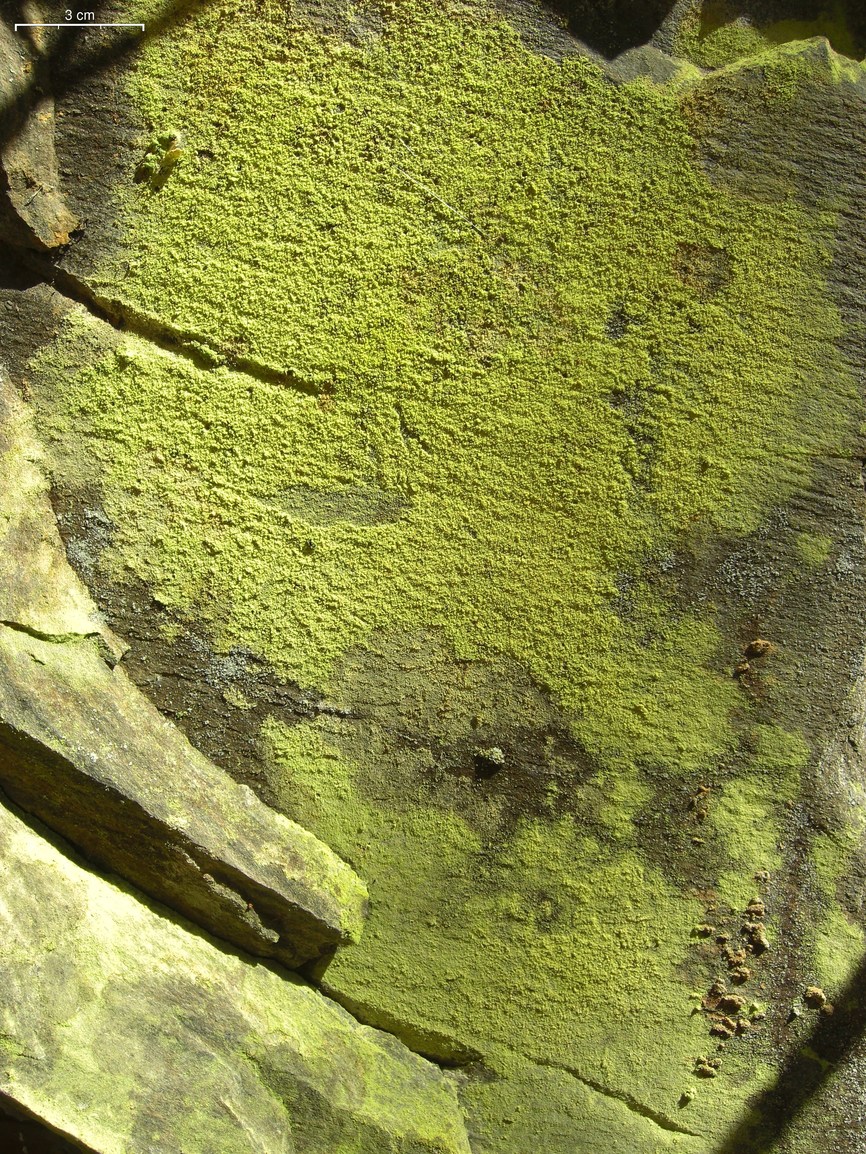
Chrysothrix chlorina is a crusty, powdery lichen with a yellow to yellow-green colour, often found on rocks in northern forests. Its name comes from Latin for yellow-green, and it has been used for dyeing in India and Sweden, producing a wide range of colours from pale yellow to nearly black.
- Forms a yellow to yellow-green powdery crust on rocks
- Used as a dye in India and Sweden
- Can produce up to 14 dye colours from pale yellow to almost black
- Distinguished by chemicals like vulpinic acid and calycin
- Known as sulphur dust lichen and brimstone-coloured lepraria
What colour is Chrysothrix chlorina?
Chrysothrix chlorina is a lichen that forms a soft, powdery crust in shades from yellow to yellow-green. It grows mainly on rocks, especially in cool, shaded places in northern forests. Its surface is made up of tiny granules, each a bundle of green algae and fungus. The lichen stands out for its bright colour and powdery texture, which can be easily disturbed by touch.
Where does Chrysothrix chlorina come from?
The name Chrysothrix chlorina comes from Latin, with 'chlorina' meaning yellow-green. It was first described by the Swedish lichenologist Erik Acharius in 1799. Over the years, it has been placed in several different genera before settling in Chrysothrix in 1981. Its common names, like sulphur dust lichen and brimstone-coloured lepraria, reflect its striking yellow colour.
How is Chrysothrix chlorina made?
Chrysothrix chlorina is not a manufactured dye but a natural lichen. Its colour comes from a mix of chemicals produced by the partnership of fungus and green algae. The main pigments include calycin, vulpinic acid, and zeorin. When used as a dye, the lichen is collected and processed to extract these colours, which can produce a wide range of shades.


Where Chrysothrix chlorina is used
In India, especially in Jammu and Kashmir, Chrysothrix chlorina is used to dye textiles. Early 19th-century Swedish studies also explored its dyeing properties, finding it could yield up to 14 different colours. The lichen is mostly found on rocks in shaded forests, but it has also been recorded on bark and other surfaces in rare cases.
Yellow around the world
What the yellow family means from country to country.
People wear yellow for Vasant Panchami, the spring festival of the goddess Saraswati. Before many weddings, turmeric paste is rubbed on the bride and groom in the haldi ceremony.
Sacred and holyFestival and celebrationWeddings and marriageJoySource: Vasant PanchamiA crime novel or thriller is called a giallo, a yellow. The name comes from the yellow covers of a series of mysteries that Mondadori began publishing in 1929.
Danger and warningFearSource: GialloThe yellow disc of the Aboriginal flag is the sun, giver of life. The flag was designed by the Luritja artist Harold Thomas and first flown in Adelaide in 1971.
Sacred and holySource: Australian Aboriginal flagAt the gaye holud, held a day or two before a wedding, relatives rub turmeric paste on the bride and groom. Guests dress in yellow and orange.
Weddings and marriageFestival and celebrationJoySource: Gaye holudOn Pohela Falgun, the first day of spring, young women wear yellow and orange saris, a shade called basanti, with flowers in their hair.
Festival and celebrationNature and renewalJoySource: Pohela FalgunThe Flemish flag is a black lion on yellow, and the Walloon flag a red cockerel on yellow. The language communities are often shown by these colours.
Politics and protestPrideSource: Flag of FlandersShades and relatives of Chrysothrix chlorina
Chrysothrix chlorina is often confused with similar yellow lichens like C. candelaris and Psilolechia lucida. It can be told apart by its chemical makeup, especially the presence of vulpinic acid. Other related species differ in their pigments and where they grow. Chemical tests are often needed to be sure of its identity.
Questions people ask about Chrysothrix chlorina
What colour is Chrysothrix chlorina?
It is yellow to yellow-green, forming a soft, powdery crust on rocks and sometimes bark.
Where does the name Chrysothrix chlorina come from?
The species name 'chlorina' comes from Latin, meaning yellow-green, describing its colour.
What is Chrysothrix chlorina used for?
It has been used as a dye in India and Sweden, producing a range of colours for textiles.
How is Chrysothrix chlorina different from similar lichens?
It is distinguished by its chemical composition, especially the presence of vulpinic acid, and its powdery yellow-green surface.
Where is Chrysothrix chlorina found?
It grows mainly in northern forests across Europe, Asia, and North America, usually on rocks in shaded places.
Good reading and sources
- Chrysothrix chlorina on WikipediaEncyclopedia
- More pictures on Wikimedia CommonsPictures
- Wikidata recordOpen data
The facts on this page come from the Wikipedia article "Chrysothrix chlorina", written by its contributors and used under the CC BY-SA 4.0 licence, and from its Wikidata record (CC0). Rang rewrote the text in its own words, with AI assistance, and compares every page with the article to make sure no passage is copied. It may be reused under the same CC BY-SA 4.0 licence with a link back.
It may contain mistakes. The swatch is an approximation: named colours are not fixed standards, and every screen shows them a little differently. If something is wrong, tell us. Last refreshed 2026-10-03.
More of the yellow family
All of yellow
Yellow
Turmeric
A golden yellow dye and spice from the rhizome of a tropical plantColour named from nature · 🇮🇳 India +5

Yellow
Orpiment
A golden-yellow mineral pigment once prized for its brilliant colour and rarityPigment · 🇪🇬 Egypt +5

Yellow
Tartrazine
A synthetic lemon yellow dye widely used in food, cosmetics and medicinesDye

#FFFDD0
Cream
A soft yellow-white named after the top layer of milkNamed shade

#E49B0F
Gamboge
A strong yellow pigment tapped from Southeast Asian treesPigment · 🇰🇭 Cambodia +5

#C2B280
Ecru
A pale, greyish yellow once named for unbleached linenNamed shade

#FADA5E
Naples yellow
A historic synthetic yellow pigment once prized by painters and pottersPigment · 🇪🇬 Egypt +1

#E3A857
Indian Yellow
A clear, glowing orange-yellow pigment once made in India from cow urinePigment · 🇮🇳 India
More colours tied to Sweden
The colours of Sweden
#87CEEB
Sky blue
A light blue named for the colour of a clear daytime skyNamed shade · 🇦🇷 Argentina +5

#801818
Falu redfalu rödfärg
A deep red paint pigment from the Falun copper mine, used on wooden houses in SwedenPigment · 🇸🇪 Sweden +2

#4D5D53
Feldgrau
A green-grey shade long used for military uniforms in Germany and beyondNamed shade · 🇩🇪 Germany +5

#A52A2A
Auburn hair
A natural hair colour blending red and brown tonesNamed shade · 🇳🇴 Norway +4