Astaxanthin
A red pigment found in algae, seafood shells, and used in animal feed
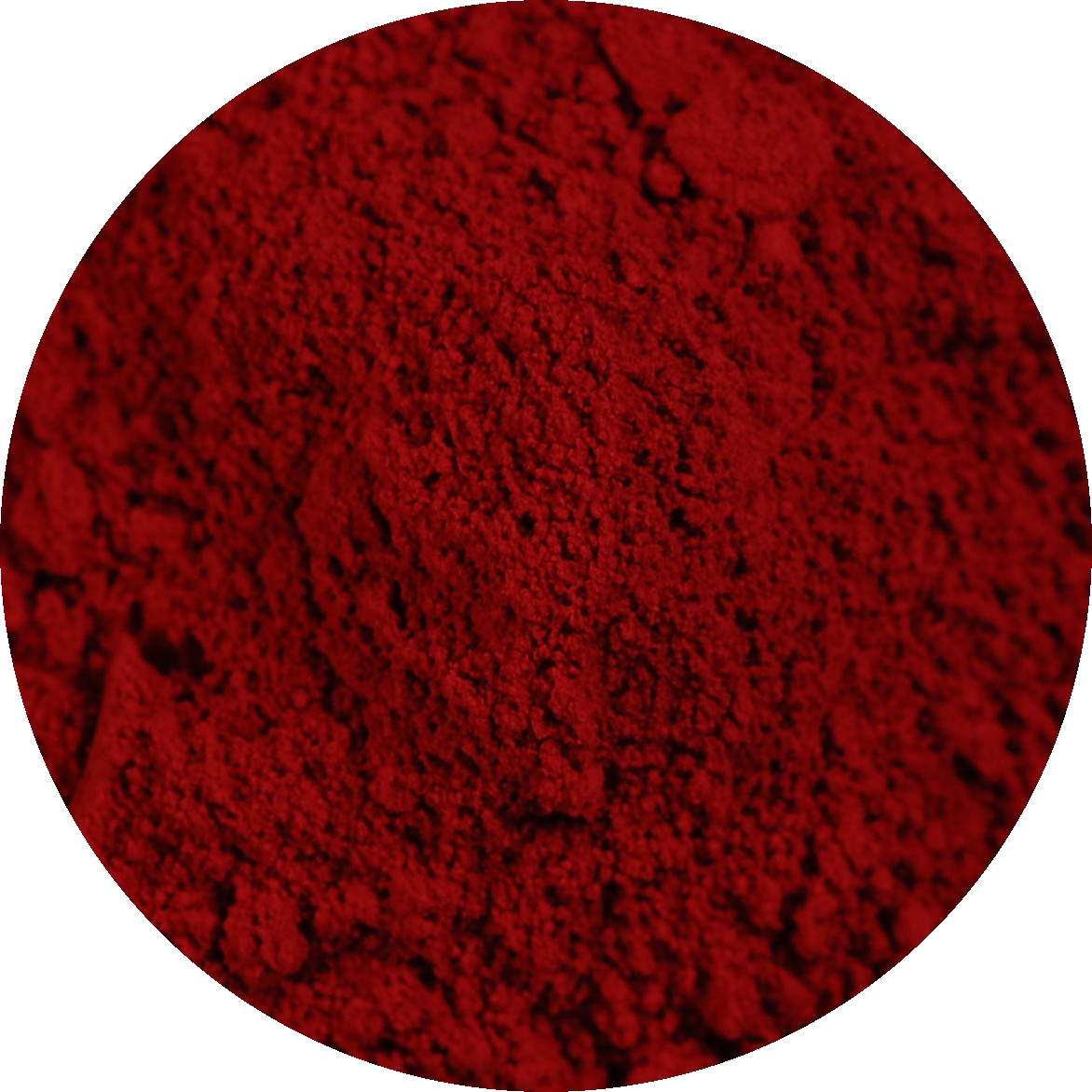
No single value: Astaxanthin is a material, and its colour varies. The background shows its family, red.

Astaxanthin is a red carotenoid pigment made by certain algae, yeast, and bacteria. It gives the pink or red colour to salmon, shrimp, and flamingos, and is widely used as a food colourant in aquaculture and animal feed. Most commercial astaxanthin is now made synthetically, though it also occurs naturally in aquatic food chains.
- Astaxanthin gives salmon and shrimp their pink-red colour
- It is produced by algae, yeast, and bacteria
- Most commercial astaxanthin is made synthetically
- Used as a food colourant in animal and fish feed
- Found in the shells of crustaceans and visible after cooking
What colour is Astaxanthin?
Astaxanthin is a red pigment that belongs to the carotenoid family, a group of compounds known for their colouring properties. It is lipid-soluble and amphiphilic, meaning it has both water-loving and fat-loving parts. Astaxanthin is responsible for the pink and red shades seen in many aquatic animals, especially after cooking. Its colour comes from a chain of alternating double and single bonds in its structure.
Where does Astaxanthin come from?
The name 'astaxanthin' comes from its chemical relationship to xanthophylls, a type of yellow pigment, and its presence in the lobster genus Astacus. It is produced naturally by microalgae like Haematococcus pluvialis and by some yeasts and bacteria. Animals such as salmon and flamingos get their red colour by eating organisms that contain astaxanthin.
How is Astaxanthin made?
Astaxanthin is made in nature by algae, yeast, and bacteria. For industrial use, it is extracted from microalgae like Haematococcus pluvialis or from krill and shrimp shells. Most astaxanthin for aquaculture is now made synthetically using chemical reactions starting from compounds like isophorone. The pigment can be found in both esterified and non-esterified forms, depending on its source.


Where Astaxanthin is used
Astaxanthin is mainly used as a food colourant in animal feed, especially for farmed salmon, trout, and shrimp, to give them a pink or red hue. It is also added to chicken feed to deepen the colour of egg yolks. In the United States and Europe, it is regulated as a food additive and is approved for specific uses in animal and fish foods. It is also sold as a dietary supplement for humans.
Red around the world
What the red family means from country to country.
The flag uses the four Pan-Arab colours: a red bar at the hoist with green, white and black bands. It was designed by a young Emirati, Abdullah Al Maainah, in 1971.
Politics and protestPrideSource: Flag of the United Arab EmiratesThe flag is a black double-headed eagle on red, the banner of the fifteenth-century hero Skanderbeg. Fans chant Kuq e Zi, red and black.
Politics and protestPrideSource: Flag of AlbaniaArmenian scribes painted manuscripts with vordan karmir, a crimson dye made from an insect that lives on the roots of grasses in the Ararat plain.
Sacred and holySource: Armenian cochinealUnder Juan Manuel de Rosas in the 1830s and 1840s, everyone had to wear a scarlet ribbon to show loyalty to his Federalist party. His enemies, the Unitarians, were tied to sky blue.
Politics and protestFearSource: Juan Manuel de RosasThe flag is red, white and red. Legend says Duke Leopold V's white tunic was soaked in blood at the siege of Acre, all but the band under his belt.
Politics and protestCourageSource: Flag of AustriaRed ochre is used in Aboriginal rock art and ceremony, and is traded over long distances. In the Aboriginal flag the red half stands for the earth and for that ochre.
Sacred and holyNature and renewalAweSource: Australian Aboriginal flagShades and relatives of Astaxanthin
Astaxanthin can exist in several stereoisomeric forms, which differ slightly in structure and are found in different proportions depending on the source. It is related to other carotenoids like canthaxanthin and zeaxanthin, but is set apart by its redder hue and unique chemical groups. Synthetic astaxanthin is a mix of all three main stereoisomers.
Questions people ask about Astaxanthin
What colour is astaxanthin?
Astaxanthin is a red pigment. It gives a pink to red colour to animals like salmon, shrimp, and flamingos.
Where does the name astaxanthin come from?
The name relates to its chemical family (xanthophylls) and its presence in the lobster genus Astacus.
How is astaxanthin made for commercial use?
Most commercial astaxanthin is made synthetically, but it can also be extracted from microalgae, krill, or shrimp shells.
What is astaxanthin used for?
It is used as a food colourant in animal feed, especially for farmed fish and poultry, and as a dietary supplement.
Why do cooked lobsters and shrimp turn red?
Cooking frees astaxanthin from proteins in their shells, making the red pigment visible.
Good reading and sources
- Astaxanthin on WikipediaEncyclopedia
- More pictures on Wikimedia CommonsPictures
- Wikidata recordOpen data
The facts on this page come from the Wikipedia article "Astaxanthin", written by its contributors and used under the CC BY-SA 4.0 licence, and from its Wikidata record (CC0). Rang rewrote the text in its own words, with AI assistance, and compares every page with the article to make sure no passage is copied. It may be reused under the same CC BY-SA 4.0 licence with a link back.
It may contain mistakes. The swatch is an approximation: named colours are not fixed standards, and every screen shows them a little differently. If something is wrong, tell us. Last refreshed 2026-10-03.
More of the red family
All of red
Red
Cinnabar
A scarlet to brick-red mineral and the main source of mercury and vermilion pigmentColour named from nature · 🇪🇸 Spain +5

Red
Realgar
An orange-red arsenic sulfide mineral once used as a pigment and poisonPigment · 🇨🇳 China +5
Red
Carmine
A deep red pigment made from cochineal insects, once prized across continentsPigment · 🇫🇷 France +2

#E25822
Scarlet
A bright red with a touch of orange, long tied to power, sacrifice and sinNamed shade · 🇹🇷 Turkey +4

#E34234
Vermilion
A brilliant orange-red pigment, once made from toxic mercury orePigment · 🇹🇷 Turkey +5

Red
Rubia
A group of plants whose roots once dyed cloth and paint a lasting redColour named from nature · 🇪🇬 Egypt +5

#E32636
Alizarin
A deep red dye first made from madder roots, later produced from coal tarDye · 🇹🇷 Turkey +1

#801818
Falu redfalu rödfärg
A deep red paint pigment from the Falun copper mine, used on wooden houses in SwedenPigment · 🇸🇪 Sweden +2