Vantablack
A super-black coating made from carbon nanotubes that absorbs nearly all visible light
No single value: Vantablack is a material, and its colour varies. The background shows its family, black.

Vantablack is a super-black coating made from vertically aligned carbon nanotube arrays. It absorbs up to 99.965% of visible light, making objects appear flat or like voids. First unveiled in 2014, it is used in science, technology, and art, though its artistic use is restricted.
- Absorbs up to 99.965% of visible light
- Made from vertically aligned carbon nanotube arrays
- First shown to the public in 2014
- Artistic use is restricted to Anish Kapoor
- Used in science, technology, and art installations
What colour is Vantablack?
Vantablack is a synthetic coating known for being one of the darkest substances ever created. It is made from a dense forest of carbon nanotubes, which trap and absorb nearly all incoming visible light. This gives surfaces coated with Vantablack a strikingly flat, black appearance, making three-dimensional objects look almost two-dimensional or like empty spaces. Its unique structure and light-absorbing properties set it apart from other black coatings.
Where does Vantablack come from?
The name 'Vantablack' combines the acronym VANTA, for 'vertically aligned nanotube arrays', with the word black. It was invented by Ben Jensen and developed by Surrey NanoSystems in the UK, with early work at the National Physical Laboratory. The material was first publicly shown in July 2014 and is trademarked by Surrey NanoSystems. The original version was made using a chemical vapour deposition process.
How is Vantablack made?
Vantablack is produced by growing a layer of vertically aligned carbon nanotubes on a surface using a process called chemical vapour deposition. Light entering the coating is trapped between the tubes and absorbed, rather than reflected. Later versions include sprayable paints with randomly oriented nanotubes or non-nanotube formulations, each requiring specific application methods and conditions.


Where Vantablack is used
Vantablack is used in scientific and technical fields to block stray light in telescopes and improve the performance of infrared cameras and sensors. Its ability to absorb nearly all light makes it valuable for optical instruments and aerospace applications. In art, its use is restricted to one artist, but variants have been used in installations, architecture, and product showcases.
Black around the world
What the black family means from country to country.
The black eagle gives the country its own name for itself: Shqiperia is commonly read as the land of the eagles.
Politics and protestPrideSource: AlbaniaBlack and yellow were the colours of the Habsburg monarchy. They come from the black double-headed eagle on a gold ground used by the Holy Roman Emperors.
Royalty and powerSource: Flag of the Habsburg monarchyThe black upper half of the Aboriginal flag stands for the Aboriginal people of Australia.
Politics and protestPrideSource: Australian Aboriginal flagOn 21 February, Language Martyrs' Day, people wear black badges and black and white clothes and walk barefoot to the Shaheed Minar to honour those killed in 1952.
Mourning and deathPolitics and protestGriefSource: Bengali language movementThe black, yellow and red of the flag come from the arms of the Duchy of Brabant: a gold lion with red claws and tongue on black. They were raised in the 1830 revolution.
Politics and protestPrideSource: Flag of BelgiumTwo diagonal stripes cross the yellow of the flag, one white and one black. They stand for the Sultan's two chief ministers.
Politics and protestSource: Flag of BruneiShades and relatives of Vantablack
Variants of Vantablack include sprayable forms like Vantablack S-VIS and S-IR, which use randomly aligned nanotubes, and VBx, a non-nanotube version. Similar super-black materials have been developed elsewhere, and other nanotube-based blacks such as Singularity Black have been released by different manufacturers. Vantablack is sometimes compared to other deep blacks like Eigengrau and International Klein Blue.
Questions people ask about Vantablack
What colour is Vantablack?
Vantablack is a super-black coating that absorbs almost all visible light, making objects appear extremely dark and flat.
Where does the name Vantablack come from?
The name combines 'VANTA', which stands for 'vertically aligned nanotube arrays', with the word black.
What is Vantablack made from?
It is made from a dense layer of carbon nanotubes grown on a surface using a chemical process.
Who can use Vantablack in art?
The artistic use of Vantablack is exclusively licensed to Anish Kapoor by Surrey NanoSystems.
What is Vantablack used for?
It is used in scientific instruments, aerospace, optical devices, and some art and design projects.
Good reading and sources
- Could Surrey Space Centre paint stop 'motorway of satellites' in sky?BBC, Article
- Vantablack, the world’s darkest material, is unveiled by UK firmSouth China Morning Post, Article
- Vantablack on WikipediaEncyclopedia
- More pictures on Wikimedia CommonsPictures
- Wikidata recordOpen data
The facts on this page come from the Wikipedia article "Vantablack", written by its contributors and used under the CC BY-SA 4.0 licence, and from its Wikidata record (CC0). Rang rewrote the text in its own words, with AI assistance, and compares every page with the article to make sure no passage is copied. It may be reused under the same CC BY-SA 4.0 licence with a link back.
It may contain mistakes. The swatch is an approximation: named colours are not fixed standards, and every screen shows them a little differently. If something is wrong, tell us. Last refreshed 2026-10-03.
More of the black family
All of black
#000000
Black
The colour seen when no visible light is present or all light is absorbedBasic colour

Black
India ink
A deep black ink made from carbon soot, used for writing, drawing and calligraphyPigment · 🇨🇳 China +1
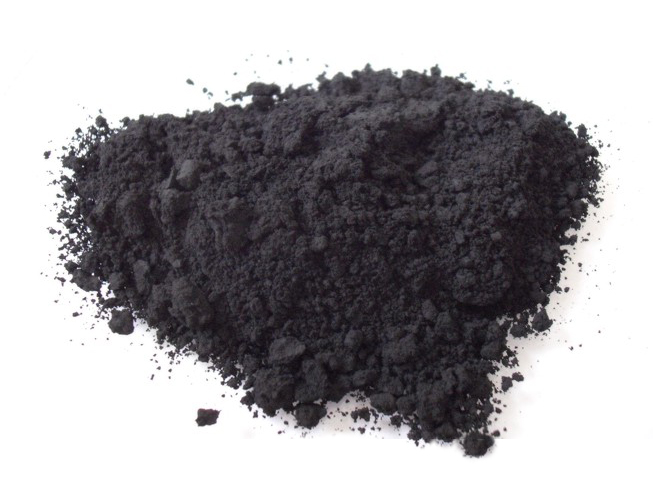
Black
Carbon black
A deep black pigment and filler made by burning carbon-rich materials with little airPigment

Black
Bone char
A deep black pigment and filter made by charring animal bonesPigment

Black
Magnetite
A naturally magnetic black mineral and a major source of ironColour named from nature

Black
Manganese dioxide
A black-brown mineral oxide used in batteries, pigments, and chemical reactionsPigment

Black
Iron(II) oxide
A black iron compound used as a pigment and found deep in the EarthPigment

Black
Cephalopod ink
A dark liquid from sea creatures, once used in pens and now in Mediterranean and Japanese foodColour named from nature · 🇯🇵 Japan +2