Ferrihydrite
A dark brown to yellow-brown iron mineral found in soils and water deposits
No single value: Ferrihydrite is a material, and its colour varies. The background shows its family, brown.

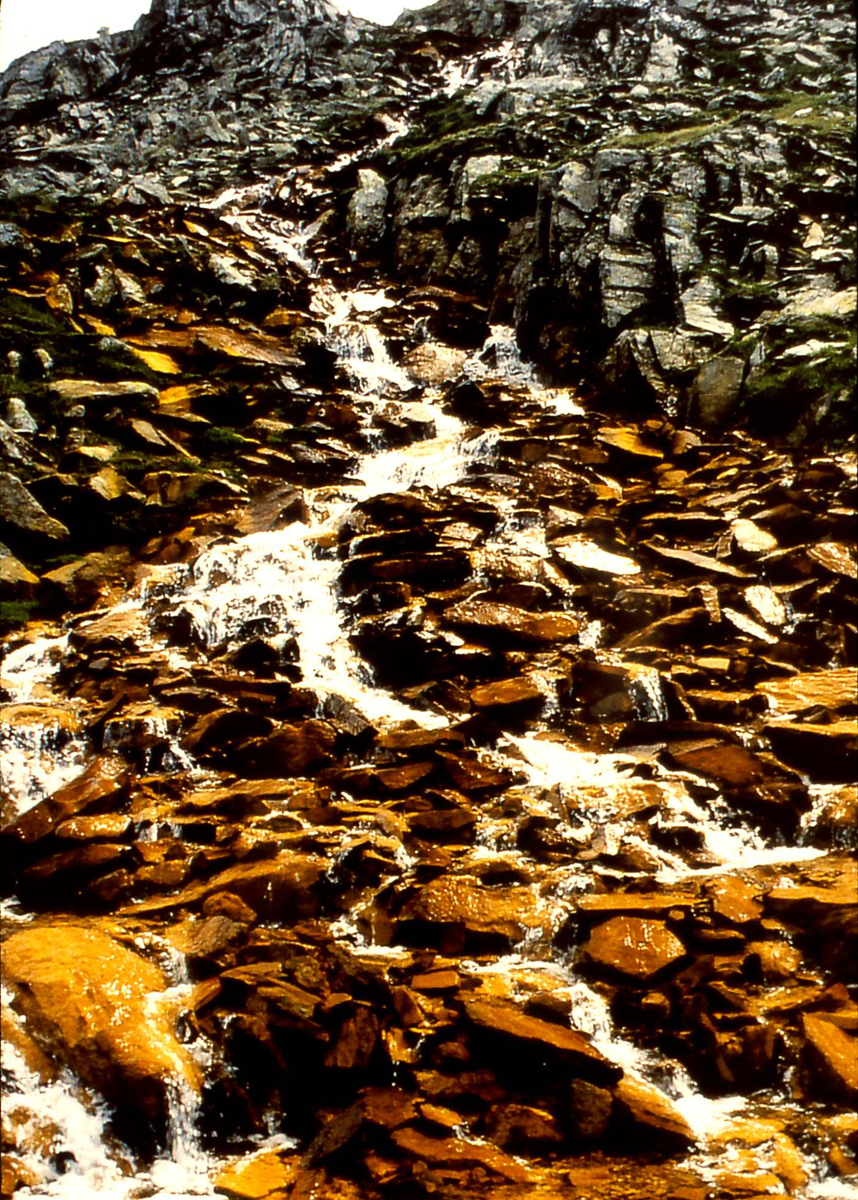
Ferrihydrite is a hydrous iron oxide mineral that appears dark brown or yellow-brown. It forms as fine-grained, nanoporous coatings in soils, water systems, and mine drainage, and is known for its ability to absorb metals and impurities from the environment.
- Forms dark brown or yellow-brown coatings in soils and water deposits
- Has a very high surface area and can adsorb metals and impurities
- Used in water purification in Germany and Japan
- Exists only as tiny, aggregated crystals
- Can be made by bacteria or from iron-rich water
What colour is Ferrihydrite?
Ferrihydrite is a mineral made of iron and water, showing as dark brown or yellow-brown coatings. It often forms as very fine, powdery or crusty layers on surfaces exposed to iron-rich water, such as logs in mine drainage or in soils. Its colour ranges from deep brown to yellow-brown, and it is always found as tiny, aggregated crystals rather than large, clear ones. Its most notable feature is its high surface area, which gives it a strong ability to attract and hold other substances.
Where does Ferrihydrite come from?
The name 'ferrihydrite' comes from its chemical makeup: 'ferri' for iron and 'hydrite' for water. It was classified as a mineral in 1973. Ferrihydrite forms naturally in many places on Earth, wherever iron-rich water meets oxygen, such as in streams, soils, and hot springs. It is also found in the protein ferritin inside living things, where it helps store iron.
How is Ferrihydrite made?
Ferrihydrite forms when iron-rich water is exposed to oxygen, either in nature or by bacterial action. It can also be produced by bacteria that absorb dissolved iron and cause it to settle out. Its exact chemical formula varies because the amount of water it contains changes. The mineral is always made up of very small, defective crystals, which makes its structure hard to define.


Where Ferrihydrite is used
Because of its high surface area and ability to attract metals and impurities, ferrihydrite is used in water purification. Plants in Germany and Japan use it to clean city water and remove harmful substances like arsenic. Its ability to hold gold and other metals is also used in industry. In nature, it can be seen as rusty coatings in areas affected by mining or in soils.
Brown around the world
What the brown family means from country to country.
Brown is the colour of Nazism in German political speech, after the brown shirts of the party's stormtroopers. To call a view "brown" is to call it far right.
Politics and protestDanger and warningShameSource: SturmabteilungMasi is bark cloth beaten from paper mulberry and printed in brown and black. It is worn at weddings and funerals and given in ceremonial exchanges.
Sacred and holyWeddings and marriageSource: Tapa clothKuntunkuni is a dark brown mourning cloth of the Asante, dyed with tree bark. Adinkra cloth, stamped with symbols, was first made on such dark grounds for funerals.
Mourning and deathSadnessSource: Adinkra symbolsThe batik of the Javanese courts at Yogyakarta and Surakarta is dyed in soga brown with indigo and cream. Some court patterns were once reserved for the royal family.
Royalty and powerPrideSource: BatikBogolanfini, or mud cloth, is cotton painted with fermented river mud in browns, black and white. Hunters wear it for protection, and women after childbirth.
Protection and healingSacred and holySource: BògòlanfiniShades and relatives of Ferrihydrite
Ferrihydrite can appear as 'two-line' or 'six-line' forms, which refer to patterns seen in X-ray tests. These forms differ mainly in how ordered their tiny crystals are. It is related to other iron oxides like hematite, goethite, and magnetite, which are more stable and have larger crystals.
Questions people ask about Ferrihydrite
What colour is ferrihydrite?
Ferrihydrite is dark brown to yellow-brown. It often appears as a powdery or crusty coating on surfaces exposed to iron-rich water.
Where does the name ferrihydrite come from?
The name comes from its chemical makeup: 'ferri' refers to iron, and 'hydrite' refers to water, as it is a hydrous iron oxide mineral.
Where is ferrihydrite found?
It forms in soils, freshwater and marine systems, hot springs, and areas affected by mining. It is also present inside living organisms as part of the ferritin protein.
What is ferrihydrite used for?
It is used in water purification to remove metals and impurities, especially in Germany and Japan. Its ability to adsorb substances makes it valuable in environmental and industrial settings.
What sets ferrihydrite apart from other iron minerals?
Ferrihydrite is always found as tiny, defective crystals with a very high surface area, making it highly adsorbent. It is less stable than other iron oxides like hematite or goethite.
Good reading and sources
- Ferrihydrite on WikipediaEncyclopedia
- More pictures on Wikimedia CommonsPictures
- Wikidata recordOpen data
The facts on this page come from the Wikipedia article "Ferrihydrite", written by its contributors and used under the CC BY-SA 4.0 licence, and from its Wikidata record (CC0). Rang rewrote the text in its own words, with AI assistance, and compares every page with the article to make sure no passage is copied. It may be reused under the same CC BY-SA 4.0 licence with a link back.
It may contain mistakes. The swatch is an approximation: named colours are not fixed standards, and every screen shows them a little differently. If something is wrong, tell us. Last refreshed 2026-10-03.
More of the brown family
All of brown
Brown
Terracotta
A clay-based material and colour, known for its reddish-brown toneColour named from nature · 🇮🇳 India +4

#8A3324
Umber
A natural brown pigment from earth, valued for its warmth and versatility in artPigment · 🇨🇾 Cyprus +2

#E97451
Sienna
A reddish-brown earth pigment named after the city of Siena in ItalyPigment · 🇫🇷 France

Brown
Catechu
A brown plant extract used as a dye, tannin, and preservativeColour named from nature · 🇯🇵 Japan +2

#824B27
Mummy brown
A transparent brown pigment once made from ground Egyptian mummiesPigment · 🇪🇬 Egypt

Brown
Goethite
A yellowish to reddish brown mineral used as a pigment since ancient timesPigment · 🇩🇪 Germany +3

Brown
Iron oxide
Earthy pigments made from iron and oxygen, found in nature and used since prehistoryPigment

Brown
Brown hair
A natural human hair colour ranging from light to very dark brownColour named from nature
More colours tied to Germany
The colours of Germany
#FF00FF
Magenta
A purplish-pink colour named after a battle and key to modern printingNamed shade · 🇫🇷 France +4

Brown
Aniline
A colourless oil that darkens with air and launched the first synthetic dyesPigment · 🇩🇪 Germany

Blue
Woad
A blue dye once vital to Europe's textile trade, made from the leaves of a flowering plantDye · 🇫🇷 France +3

#F5F5DC
Beige
A pale, warm colour named after natural, undyed woolNamed shade · 🇫🇷 France +2