🇳🇴 The colours of Norway
2 meanings recorded, 12 colours tied to the country and 3 colour cities.
Norway’s flag features deep red, dark blue, and white. The red field with a blue cross outlined in white is said to reflect Norway’s historical ties to Denmark and Sweden. The colours are officially described as deep red and dark blue, with white borders, but their symbolic meanings are not formally defined.
#BA0C2Fdeep redReflects historical ties to Denmark; no official symbolic meaning stated#00205Bdark blueRepresents historical connection to Sweden; no official symbolic meaning statedWhere no official value is given, the swatch shows the colour family, not the exact shade.
- The flag’s cross is shifted towards the hoist side.
- Pantone 200 and 281 are the standard colours used by flag makers.
- The flag’s design was adopted in 1821.
- Red and blue reflect Norway’s ties to Denmark and Sweden.
- There are strict rules for flag proportions and handling.
The colours of the flag of Norway
Norway’s flag is made up of a red field with a blue cross outlined in white. The cross is shifted towards the hoist, following the Scandinavian tradition. Official documents describe the colours as deep red and dark blue, with white as the border. The flag’s design is based on the Danish flag, with the blue cross added to reflect the union with Sweden. There is no official explanation for what each colour stands for, but the red and blue are often linked to Norway’s historical unions with Denmark and Sweden.
How the colours were chosen of Norway
Early Norwegian flags featured animals like lions, ravens, and dragons, often in gold or red. The current flag, designed in 1821 by Fredrik Meltzer, was inspired by the Danish flag and the union with Sweden. The red field comes from Denmark’s Dannebrog, while the blue cross was added to symbolise the connection to Sweden. Over time, the flag changed to reflect Norway’s shifting alliances, including a period with a union badge combining Swedish and Norwegian colours. The current flag has been in use since 1899, after the union badge was removed.
Official shades and rules of Norway
The flag’s proportions are 16:22 for the national flag and 16:27 for the state flag. The widths of the coloured elements are set by law. The official colours are described as deep red and dark blue, but no specific colour system is legally required. In practice, flag makers use Pantone 200 for red (#BA0C2F) and Pantone 281 for blue (#00205B). There are detailed rules for when and how the flag should be hoisted and lowered, and for respectful handling.
The facts in this overview come from the Wikipedia article "Flag of Norway", written by its contributors and used under the CC BY-SA 4.0 licence. Rang rewrote the text in its own words, with AI assistance, and compares every page with the article to make sure no passage is copied. It may be reused under the same CC BY-SA 4.0 licence with a link back.
What colours mean in Norway
Customs vary by region, faith and family; these are the meanings most often recorded.
The flag is red with a blue cross edged in white. The colours were chosen in 1821 to echo the flags of free countries such as France and the United States.
Politics and protestPrideSource: Flag of NorwayIn their last spring at school, students called russ wear overalls for weeks of parties that end on 17 May, Constitution Day. Most wear red, and business students wear blue.
Festival and celebrationJoySource: RussefeiringColour cities of Norway
 🇳🇴 Bergen's Hanseatic wharfBryggenA row of pointed wooden warehouses in red, ochre and white along the harbour of Bergen.
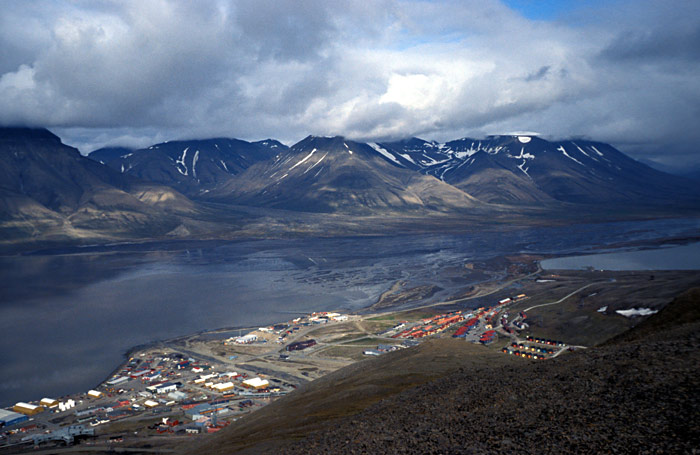 🇳🇴 The colour-planned Arctic townLongyearbyenOne of the world's most northerly towns, where rows of houses follow a designed scheme of warm colours.🇳🇴 Red cabins of LofotenReineA fishing village in the Lofoten islands where red cabins on stilts stand below sharp grey peaks.
Colours tied to Norway
Photo credits on this page
The small pictures above come from Wikimedia Commons under free licences. Some are cropped to fit.
- Bryggen No: Unknown author, CC BY-SA 2.5, source
- Longyearbyen No: Unknown author, CC BY-SA 3.0, source