Systems and standards
CIE Lab and colour difference
A colour space built on human vision, where distance between two colours roughly matches how different they look.
Presented by ClearTrust Free for designers, students and the curious.
CIE Lab, written L*a*b*, is a way of describing colour that is based on how people see, not on any screen or ink. It has three axes: lightness, a green to red axis and a blue to yellow axis. It was designed so that equal distances look like roughly equal differences. That makes it possible to put a single number, called Delta E, on how far apart two colours are.
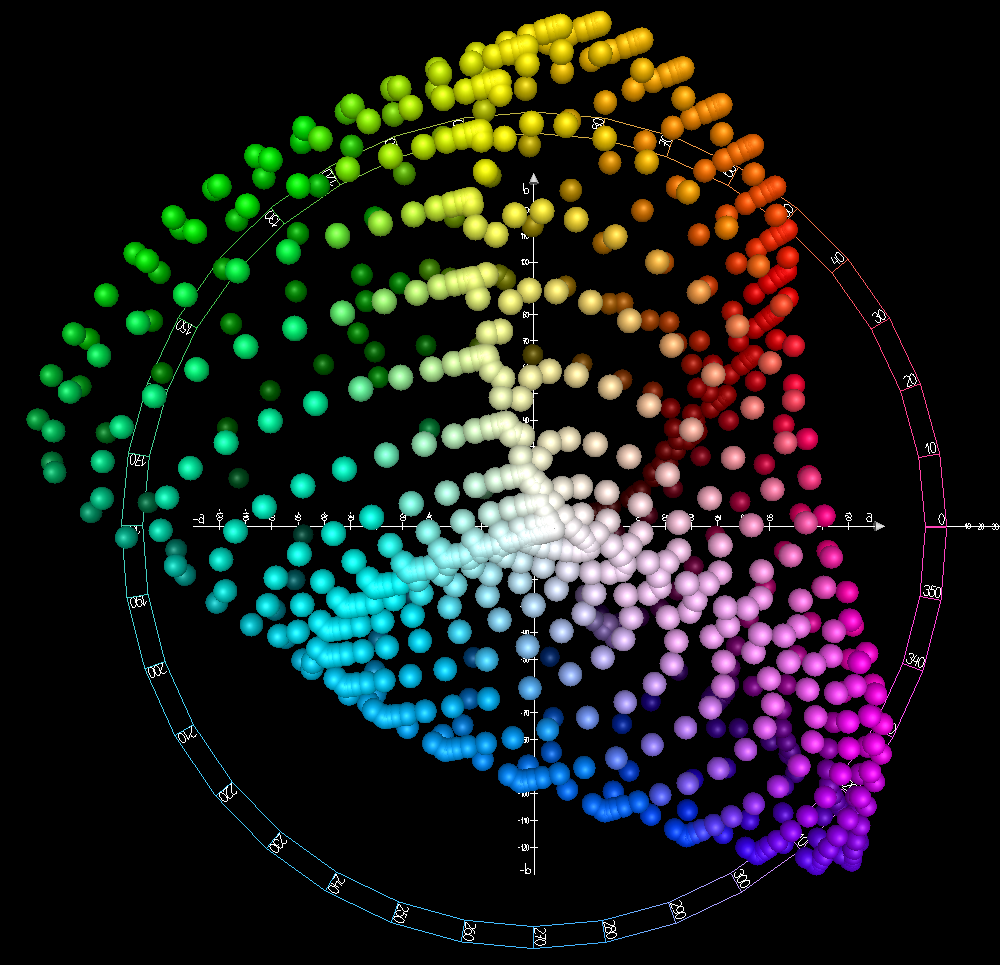
Where it comes from
The CIE is the International Commission on Illumination, based in Vienna and known by its French initials. In 1931 it defined a standard observer, an average of how a small group of people in London matched colours using three lights. Every measured colour could then be given three numbers, called XYZ. This system is still the foundation of colour measurement. Its weakness was that equal steps in the numbers did not look equal. In 1976 the CIE published Lab, a mathematical reshaping of XYZ that evens the steps out.
The three axes
L* is lightness, from 0 for black to 100 for white. The a* axis runs from green at the negative end to red at the positive end. The b* axis runs from blue to yellow. A neutral grey has a* and b* of zero. The pairs echo the opposing colour channels of human vision. Because Lab describes the colour itself, not a device's instructions, it is used as the neutral meeting point when converting between a camera, a screen and a printer. Image editing programs offer it as a working mode.
Delta E
Delta E is the distance between two colours in this space. As a rough guide, a difference of about 1 is the smallest a trained eye can see side by side, around 2 to 3 is visible at a glance, and above 5 looks like a different colour. Factories use it to accept or reject batches of paint, plastic, fabric and printed packaging. The original 1976 formula is uneven, especially for blues and strong colours, so industry now mostly uses a corrected version from 2000 known as CIEDE2000. Reviews of screens report average Delta E as a measure of accuracy.
Sources and further reading
- CIELAB color space on Wikipedia
- MDN Web Docs: lab()
- X-Rite: LAB Color Space and Values
- University of Rochester, Gaurav Sharma: The CIEDE2000 Color-Difference Formula
- International Commission on Illumination (CIE)
Original text by the Rang desk, written with AI assistance and checked against the sources above. Meanings of colour vary from place to place and person to person. If we have something wrong, tell us.